
Give yourself permission to practise and play
What if the goal is to learn, practise, play, make mistakes, and slowly build the confidence to keep going?
A statement I hear from students who have attended my workshops goes something along the lines of:
“I’ll never be as good as you.”
or
“I wish I was as good as you.”
I understand why people say it.
I know it is intended as a compliment.
But I don’t particularly like it.
Not because I’m offended.
Because I feel they assume that the artwork they’re seeing and responding to is the result of something that came easily.
That it somehow “just happened”.
It didn’t.
It is the result of time.
Time spent pushing through my own self-doubt and criticism.
Time practising and playing.
Time doing, failing, experimenting, making mistakes, learning, trying again and slowly improving.
What I wish students knew is this:
You can become confident, proficient and highly skilled in anything you learn at a workshop, investing your own time, practice and play.
If you want to.
And in your own unique way.
When you attend a workshop, any workshop, it is unfair to expect that you’ll become an expert in that process the very next day, or even the day after that.
During a workshop, you might spend one or two days learning a new skill. But there is so much more happening than simply learning the process itself.
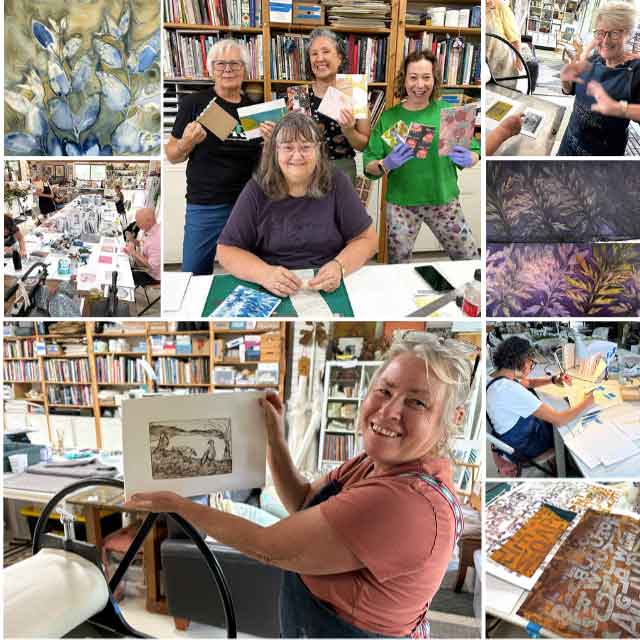
In a printmaking workshop, students are learning how to use unfamiliar tools, inks and papers. They’re learning about pressure, registration, composition, colour, mirror-image thinking, problem-solving and decision-making. And they’re doing all of that while learning the process they actually came to study.
That’s a lot!
Give yourself some credit.
Learning takes time.
Developing a new skill set takes time.
Finding your own aesthetic within a process you have only just learned takes time.
Years ago, I wrote about it taking ten years to become an overnight success.
I still believe that.
There are very few shortcuts. In art, and in life.
If I find a shortcut that doesn’t compromise the integrity of my work, I’ll happily take it. I do look for them.
But after many years of making art, I’ve learned that most growth comes from showing up repeatedly and doing the work.
The same is true for every artist whose work you admire.
Behind every artwork hanging in a gallery is a pile of prints or canvases that didn’t work.
Behind every social media post is a curated moment and a collection of culled photos.
Behind every finished artwork are countless experiments, failures, lessons and discarded ideas.
What you’re seeing is not the whole story.
I am self-taught in most of the printmaking processes I practise.
I’ve attended workshops, in person and online.
I’ve had play days with art friends.
I’ve read books.
I’ve spent countless hours looking at beautiful work created by artists around the world.
I sometimes see their work and think:
“I wish I could do that.”
or
“I wish I was that good.”
I suspect most artists do. Even accomplished artists.
The distinction is that the artists we admire kept going.
They put in the time.
They practised.
They experimented.
They failed.
And then they did it all again.
As I write this, I’m writing as much to myself as I am to anyone reading.
I still have so much to learn.
I’m still learning.
I’m still making mistakes.
I’m still trying to create work that lives up to the ideas in my head.
The reality is that there are only so many hours in a day.
Life happens around our creative practice.
Family.
Work.
Health.
Responsibilities.
Laundry.
The adult life many of us imagined would be full of freedom often turns out to be far more complicated, layered and messy than expected.
So perhaps the goal isn’t to fast-forward to mastery.
Perhaps the goal is to enjoy the journey.
To enjoy learning.
To enjoy the play.
To enjoy not knowing yet.
When you attend a workshop, learn the skills.
Then take them home.
Experiment.
Practise.
Adapt them.
Make them your own.
Put in the time, as and when you can.
Give yourself permission to practise and play.
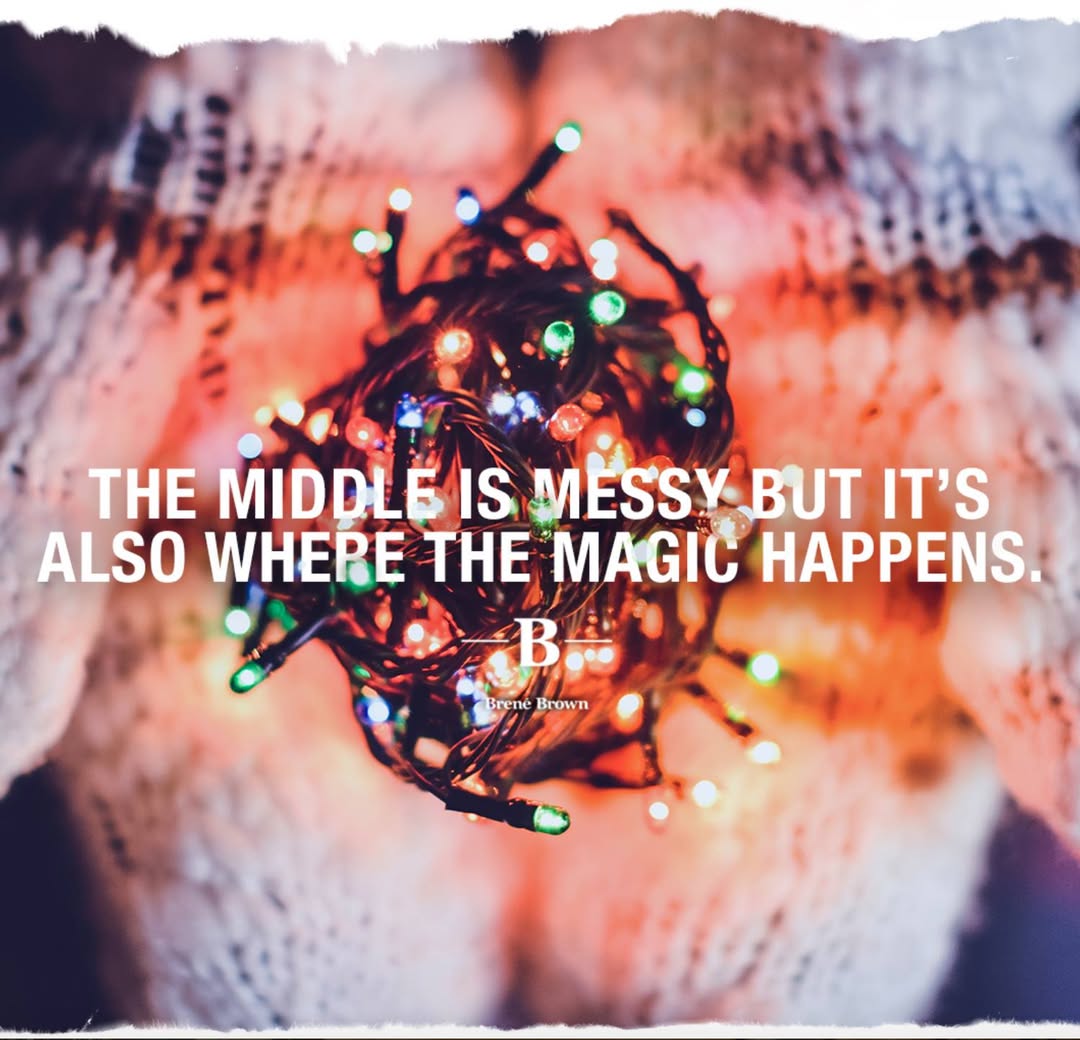
Brené Brown says, “The middle is messy, but it’s also where the magic happens.”
I love that!
That messy middle is where the real work happens.
It’s where we practise, play, make mistakes, try again and slowly begin to find our own way.
Not every piece needs to be finished, framed or kept. Some work exists simply to teach us.
That is where the growth is.
That is why practice and play are not waste.
And remember that every artist you admire started exactly where you are now.
At the beginning.
Doing the work.