
Living Traces: the physical presence of plants

A landscape is often seen as something viewed from a distance.
In Living Traces, one of the groupings of artwork in my Ghosts of Gondwana exhibition, you encounter it through physical contact.
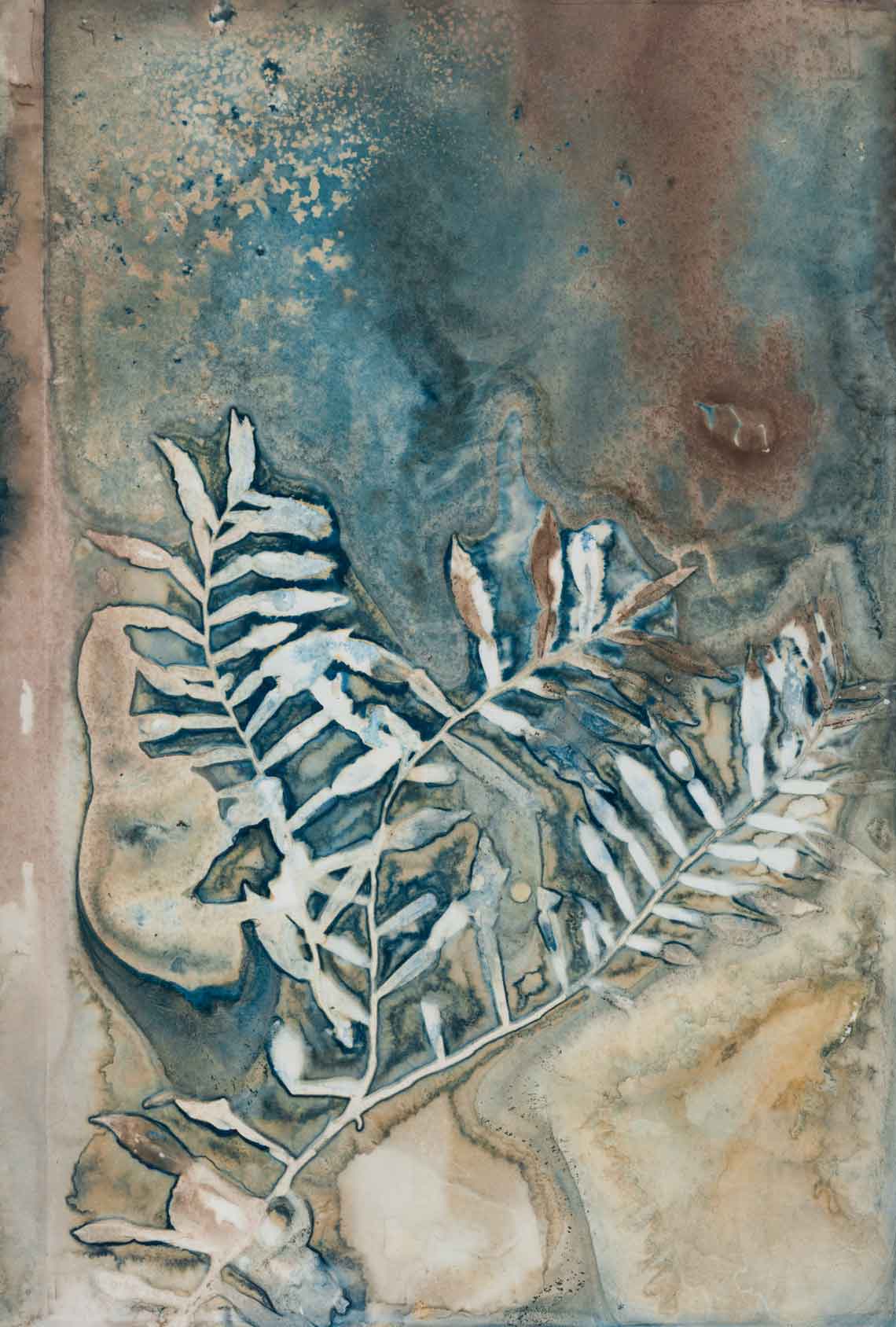
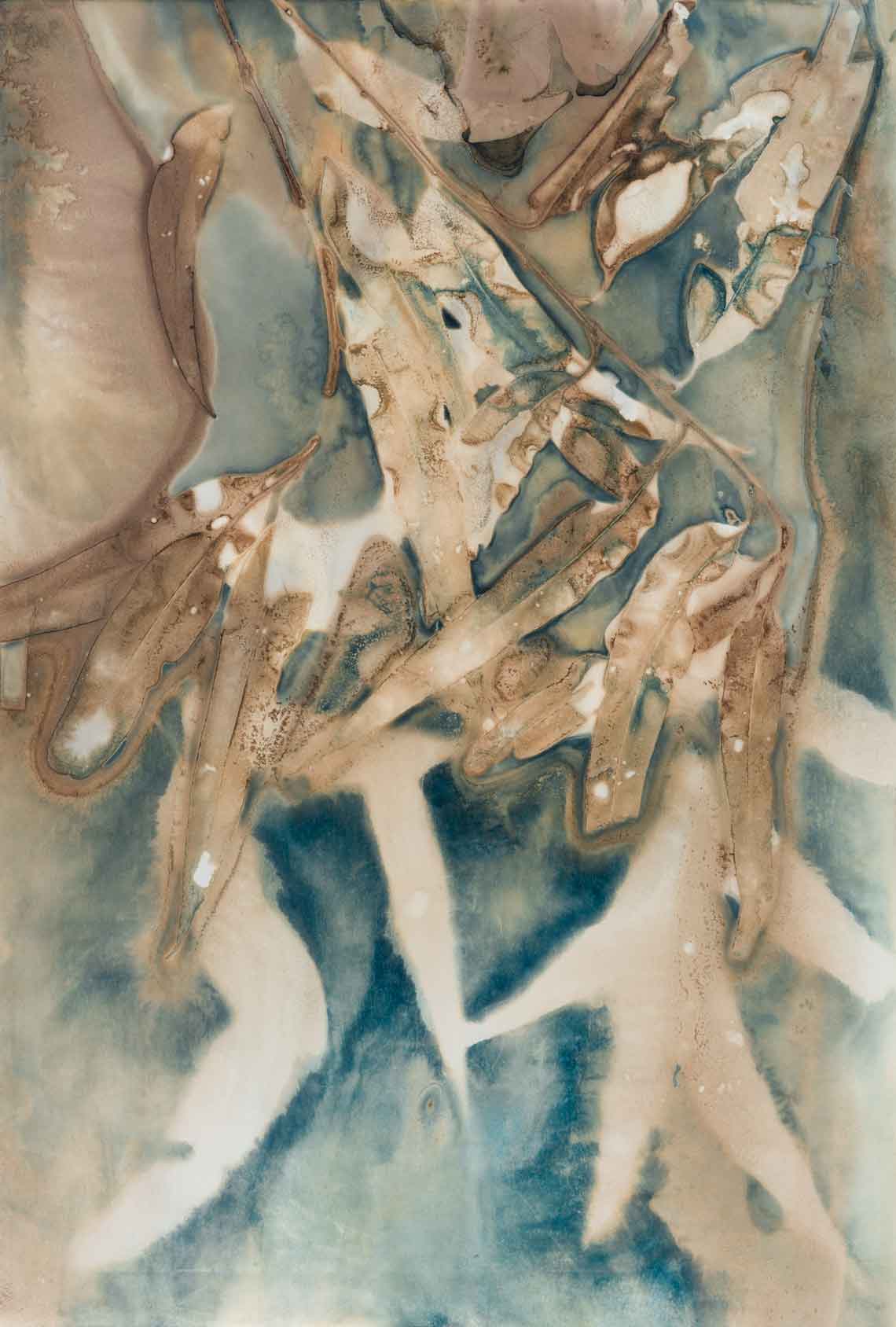
Plant material was placed directly onto cyanotype-coated paper and exposed to sunlight. The plant forms blocked and filtered the light. After the paper was washed, a record of their presence remained.
The plants are both subject and participant.
Their physical forms helped make the images.
These works directly record plants that touched the paper. Their traces speak of endurance, adaptation and resilience within a landscape continually shaped by water, light and time.
A third way of looking
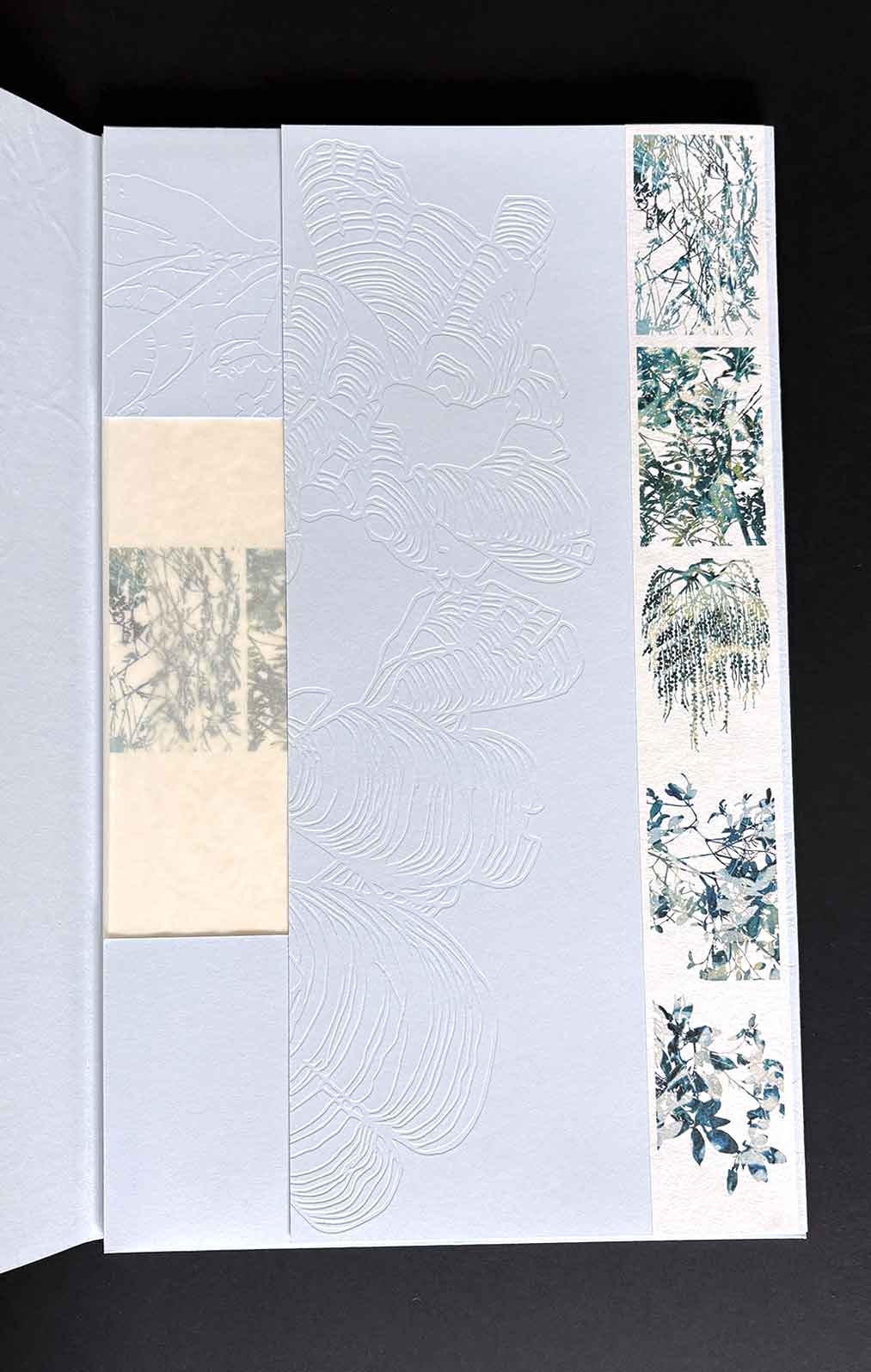
I had already used plant material to create the cyanotypes in my Hidden Relationships series. Those papers were later lasercut into plant forms and floated in their frames above blind embossings.
I wanted to keep working directly with plants, but I didn’t want the third series to look or feel the same.
Living Traces became another way to look at and experience the forest.
Close Attention begins with my photographs. Particular details are isolated and translated into stencils.
Hidden Relationships brings plants together with the birds and insects connected to them.
Living Traces is more direct and immediate.
The plant material makes physical contact with the paper. Its true scale remains within the finished work. Yet, removed from the visual complexity of the forest, the plant can feel larger and more present.
The plants within Living Traces
Pteridium esculentum
Hard bracken
I have always liked bracken.
I use it in other printmaking processes and continue to return to the feel of its fronds and the detail within its branching structure.
The structure divides and divides again. Smaller sections repeat and contribute to the form of the whole.
Hard bracken is a common groundcover in our forests. It grows, dies back and returns with remarkable resilience.
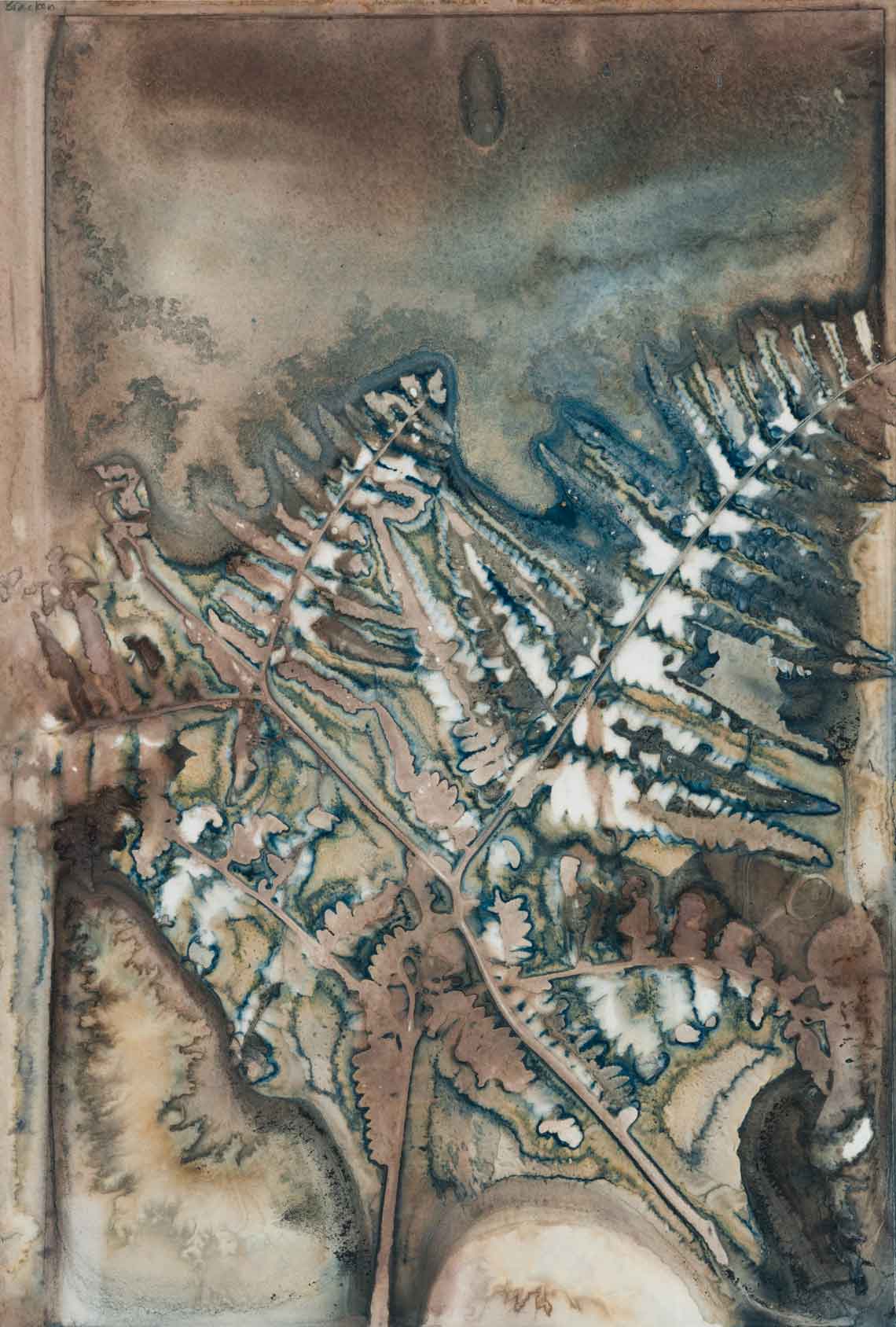
In this work, a wet cyanotype of bracken sits over a botanical monotype of the same plant. Both processes record direct contact, creating two traces of bracken within one image.
The repeated leaves and scalloped edges form a network across the paper. The finished work reminds me of an aerial landscape.
Pothos longipes
Candle vine
I first noticed candle vine at Mary Cairncross Scenic Reserve during the 2019 BioBlitz.
I was drawn to the shape of the leaves. Each suggests a candle and its flame.
Candle vine climbs using roots that attach to supporting surfaces. It holds close to the tree as it grows, occupying the spaces between larger plants and adding another layer to the forest.
The specimen used for this work was young, with relatively small leaves.
The wet cyanotype of candle vine sits over the botanical monotype of bracken. Their overlapping traces bring two different plant forms together, echoing the layered growth of the forest.
Freycinetia excelsa
Narrow-leaved climbing pandan
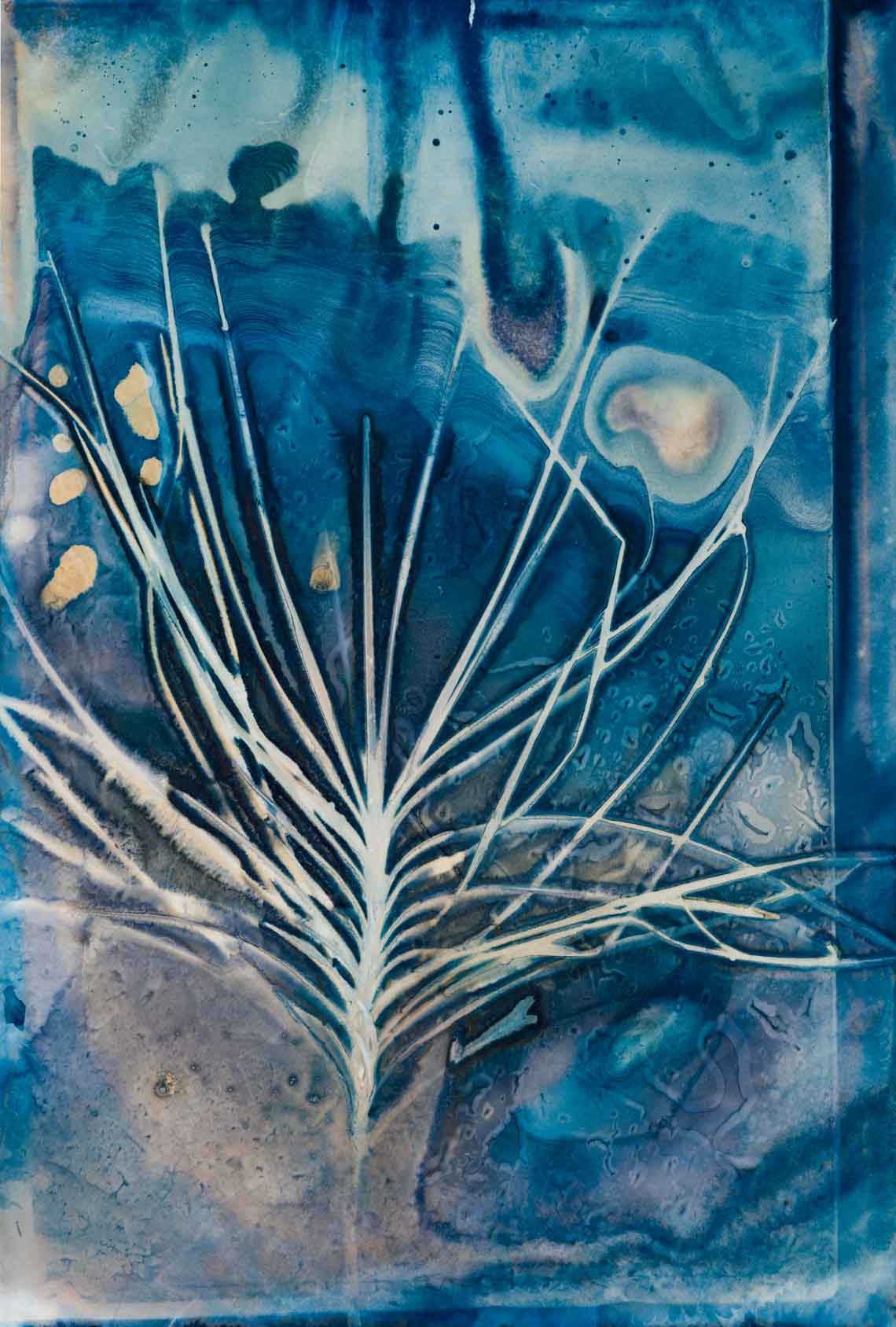
At first, I noticed its long, thin leaves moving across the forest floor. They appeared sparse and loose, extending in different directions.
Then I looked further and realised the plant was climbing through the surrounding trees.
I became fascinated by how it occupied the forest. Rooted in the ground, it reached upwards through other vegetation.
Its leaves seemed to dance.
I wanted the finished image to retain the movement that first caught my attention.
The print holds the plant still, but its long leaves continue to reach across the paper. Their movement gives the image its own rhythm.
Podocarpus elatus
Plum pine
My first visit to the property, in November 2024, was the first time I had properly noticed a plum pine.
I loved its deep green colour and leaf shape. I was also drawn to the fact that it is a conifer, connecting it in my mind with the bunya, another tree I love.
Plum pine belongs to the podocarps, a conifer lineage with a long fossil history. Its presence connects that deep history with the life growing in the forest today.
From a distance, the tree can appear dense and solid. Close up, spaces open between its stiff branches and narrow leaves.
That stiffness affected how the plant rested against the paper and how light moved around it.
This is a leaf from a tree growing in the forest today, connected to a plant lineage extending deep into the past.
Eucalyptus
A leaf can recall a whole tree.
I have always loved eucalyptus, especially its smell.
Holding the leaves brings that familiar scent close. The experience connects the tree with touch and memory as much as sight.
On this property, rainforest and eucalypt forest grow close together. Moving between them changes the vegetation, smell, temperature, light and feeling of the surrounding landscape.
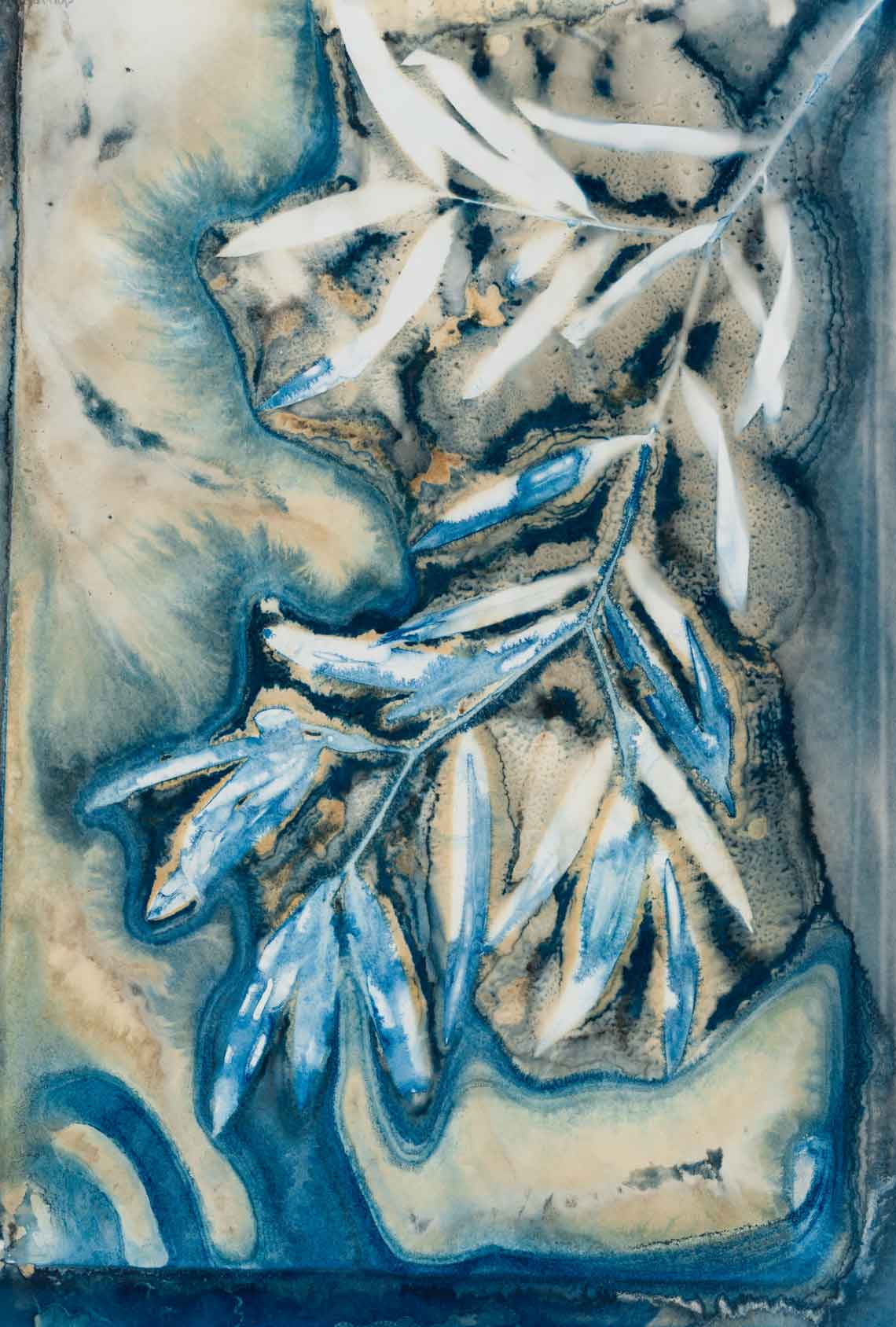
For this work, I wanted to capture movement and the sense of leaves hanging down into the frame from the tree above.
The print shows the leaves, but my experience of the plant extends beyond what is visible.
It holds the feel of a leaf, its scent and the tree it came from.
Influence, not control
The plants were collected across several visits to the property.
Some had fallen. Others were carefully cut. Everything was gathered with the knowledge and permission of the owners, with full respect for the place.
Before coating the papers with cyanotype chemistry, I printed a botanical monotype of bracken onto each sheet. This gives the five works a shared layer beneath their individual plant forms.
Some of those printed marks remain easy to see. Others sit quietly beneath the cyanotype.
I placed and layered the plant material, adding water and tannin before exposing the work to sunlight. The tannin helped influence the colours within the finished images.
I had influence, but not control.
I chose the plants and positioned them on the paper. I decided where to create layers and where to leave space.
Then sunlight, water, chemistry and the physical character of each plant became part of the making.
Water moved.
Leaves shifted.
Light travelled around the plant material.
Some edges remained clear.
Other edges softened, blurred or separated into layers.
Physical scale, isolated view
Like the Close Attention works, the finished papers float within their frames.
There is no surrounding landscape to provide context. Each plant fragment occupies the image on its own.
The works preserve the physical scale of the collected plants, but isolation changes their presence.
Bracken becomes a landscape.
A vine records layered growth.
Eucalyptus leaves carry touch and memory.
A plum pine leaf brings deep time close.
Climbing pandan holds a moment of movement.
These plants do not need to be rare or spectacular to deserve our attention. Bracken, vines and eucalyptus can become so familiar that we stop seeing them.
Living Traces asks us to notice their physical presence and appreciate the vegetation growing around us.
The works hold traces of endurance, adaptation and resilience. They were shaped by the same forces that continually shape the forest: water, light and time.
Once the plants were removed, their bodies were absent.
Their presence remained.
Living Traces is one of four sections within Ghosts of Gondwana: In the Company of Trees. You can read an introduction to the exhibition in Four ways of looking: inside Ghosts of Gondwana.
All five Living Traces works are included in the Ghosts of Gondwana online exhibition catalogue, with dimensions, prices and current availability.
The exhibition continues at The Little Red Cottage art + ecology space in Maleny until Sunday 1 November 2026.