
Forest Time – an Artist Book
Forest Time began with a collection of papers. It ends with an invitation to return to the forest and continue the conversation.
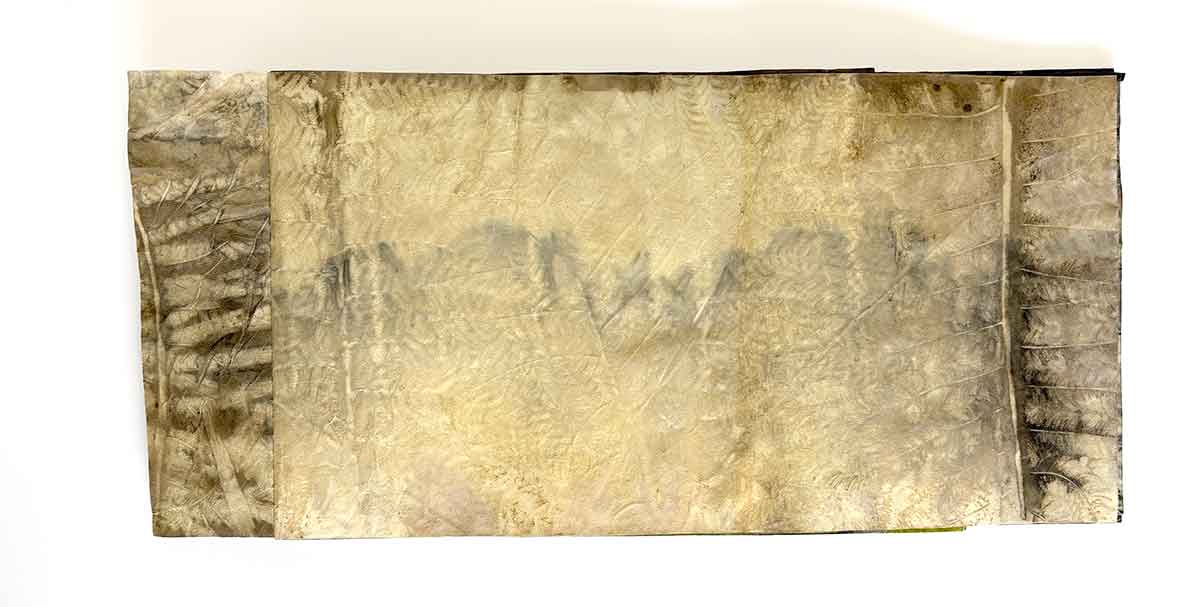
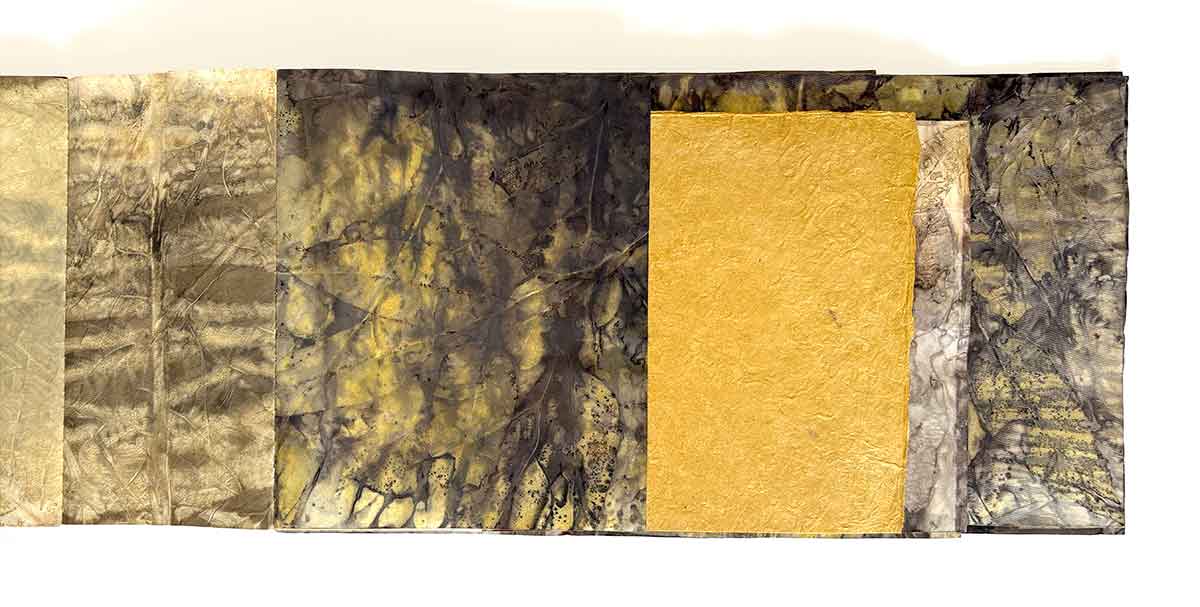
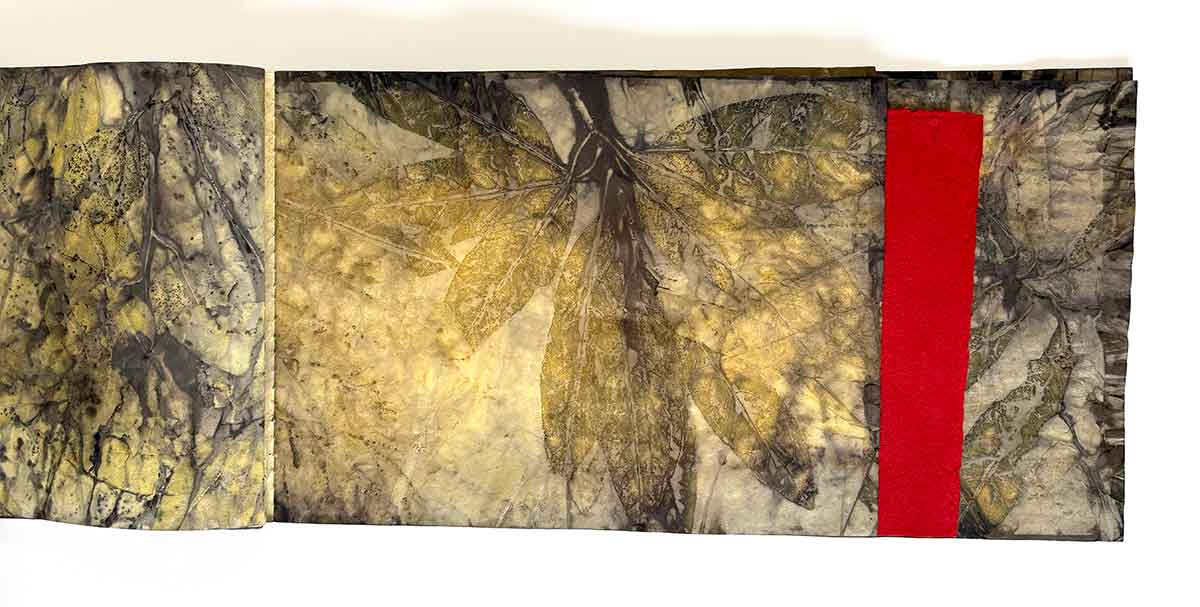
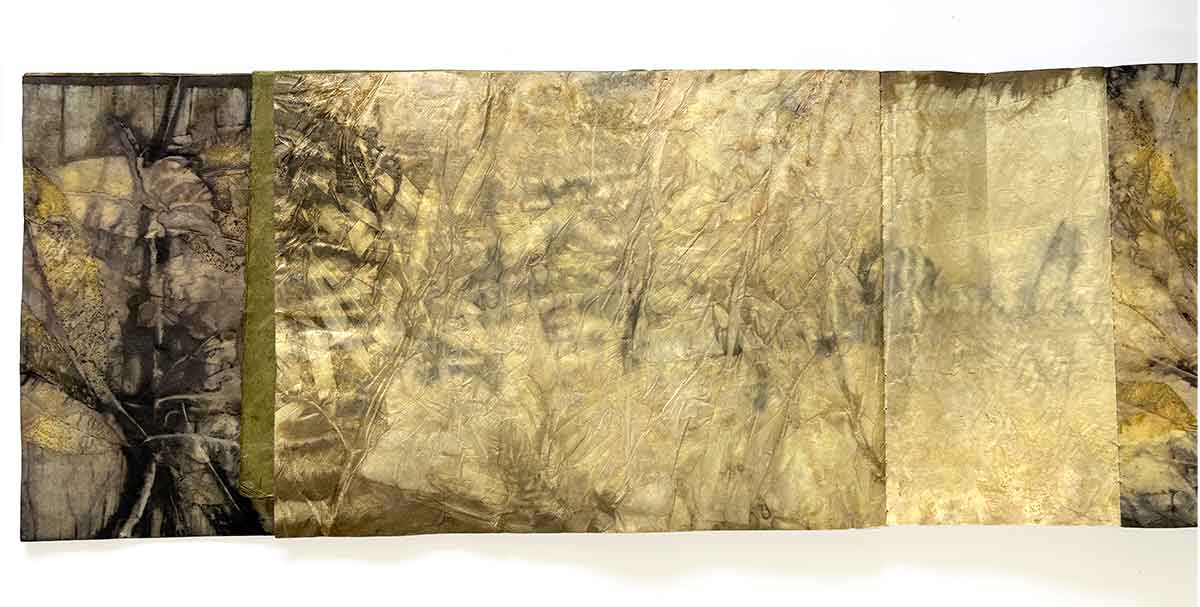
Over several months, I eco-printed large sheets of printmaking paper using leaves gathered from the property at the centre of my Ghosts of Gondwana exhibition.
Tree fern. Eucalyptus. Red cedar. Blue quandong. Plum pine. Black bean.
I wanted to record the physical impressions of those leaves. I love the marks created through eco-printing, so using the plants from the property felt like an obvious place to begin.
When I eco-printed the papers, I did not know exactly what they would become.
Above: A fast-forward page-turning video. Total time: 1 minute 18 seconds.

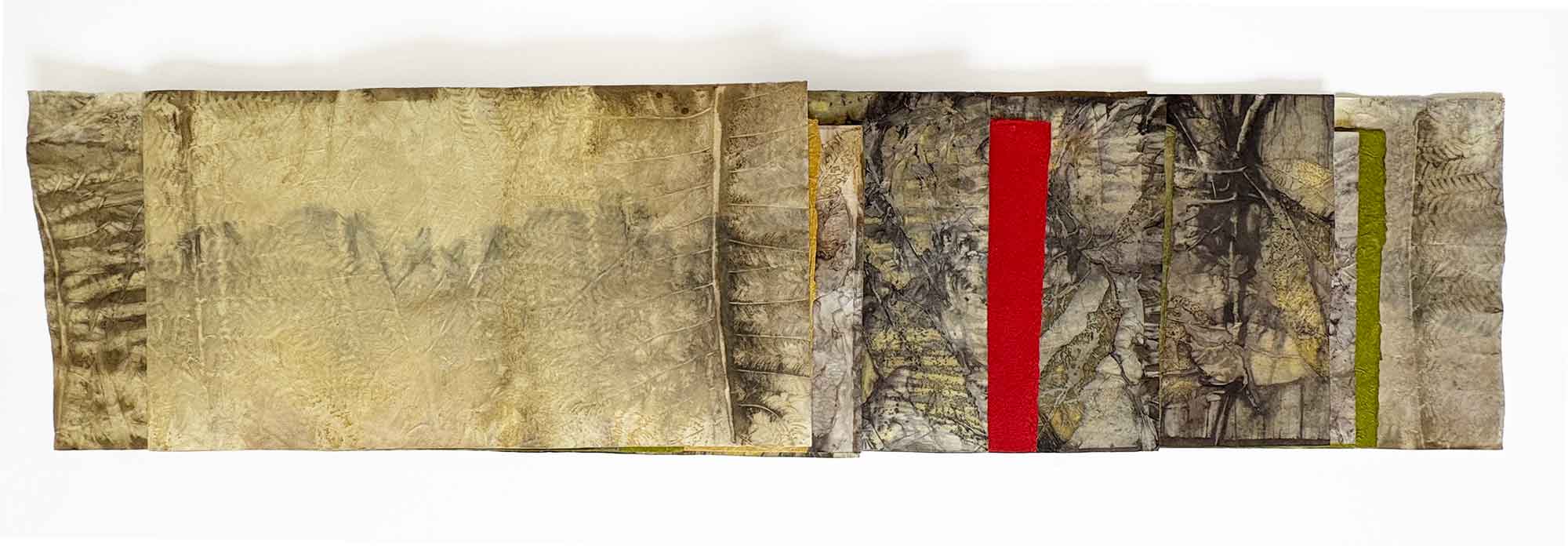
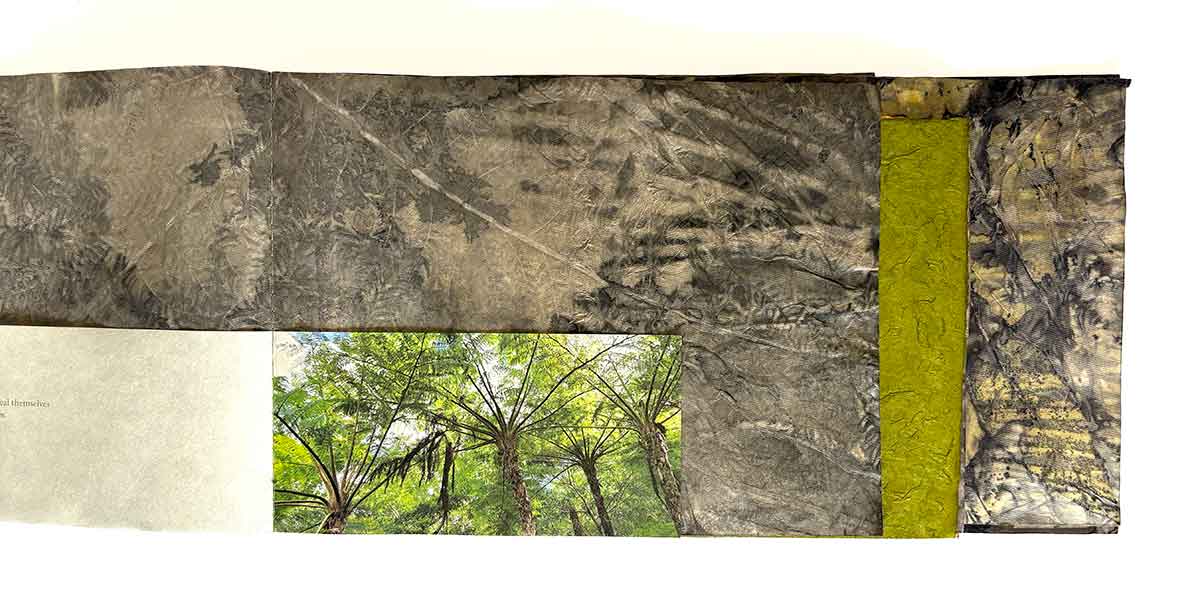
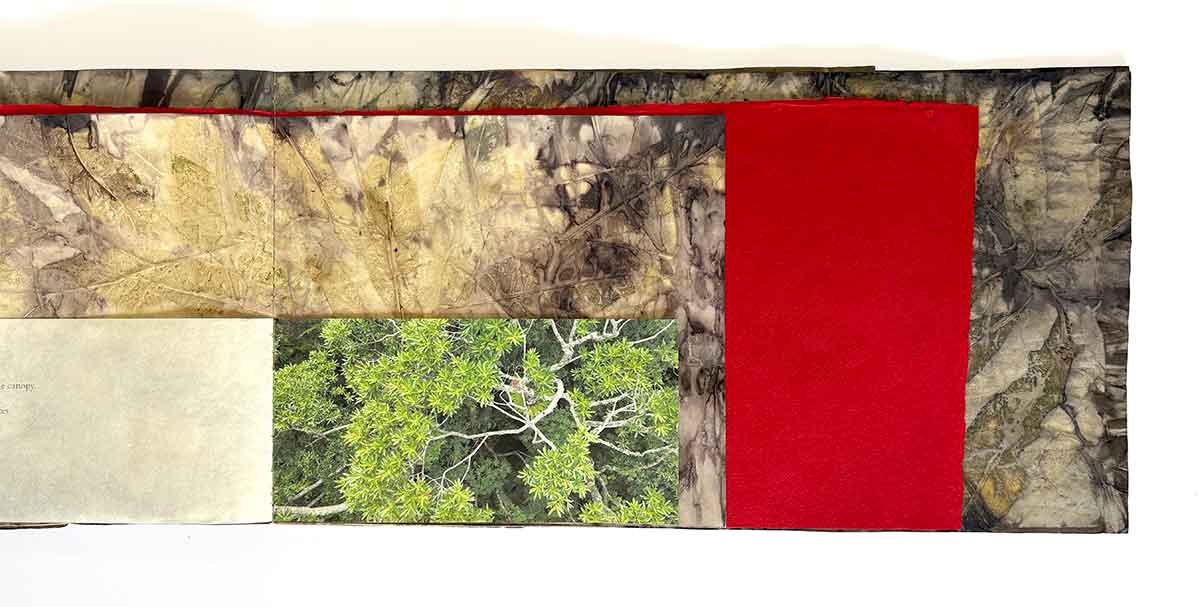
Above: Forest Time extended, with its five sections closed. Total length approx 1.75 metres. Each section is sewn to a mountain fold in the concertina spine. The book has no separate front or back cover. Here, the spine is open flat, extending the book across the table.
Letting the papers remain whole
Some leaves produced strong, clear impressions. Others left quieter marks, faint traces or areas of colour.
Individually, I wasn’t sure that every sheet worked.
Together, they became something else.
The differences began to matter.
A forest is layered, crowded and complex. Many lives occupy the same space. Edges overlap. One form interrupts another. Some things attract our attention while others remain almost unnoticed.
Stopping within that complexity creates stillness.
That contrast became important to the book.
The quieter marks belonged beside the stronger ones. Empty areas mattered. Their differences contributed to the rhythm of the book.
Their size mattered too.
The largest sheets began at approximately 76 × 28 centimetres. Folded off-centre, they formed pages more than half a metre long. Their scale gave the book the physical presence I wanted.

When the book became a walk
My first idea was to organise the book around six themes from the exhibition: awe, belonging, resilience, interconnectedness, deep time and return.
Each idea belonged within the work, but the structure began to feel too deliberate. I was trying to make particular plants and papers carry specific meanings.
Eventually, I stopped.
I laid the papers out and allowed their colours, marks and relationships to establish the sequence.
That changed the book.
It became less about explaining the forest and more about creating the conditions for noticing.
The papers began to form a walk.
Not one particular walk and not a botanical record of the property. The book grew from my time in this forest, but I wanted the experience to feel familiar to anyone who has spent time among trees.
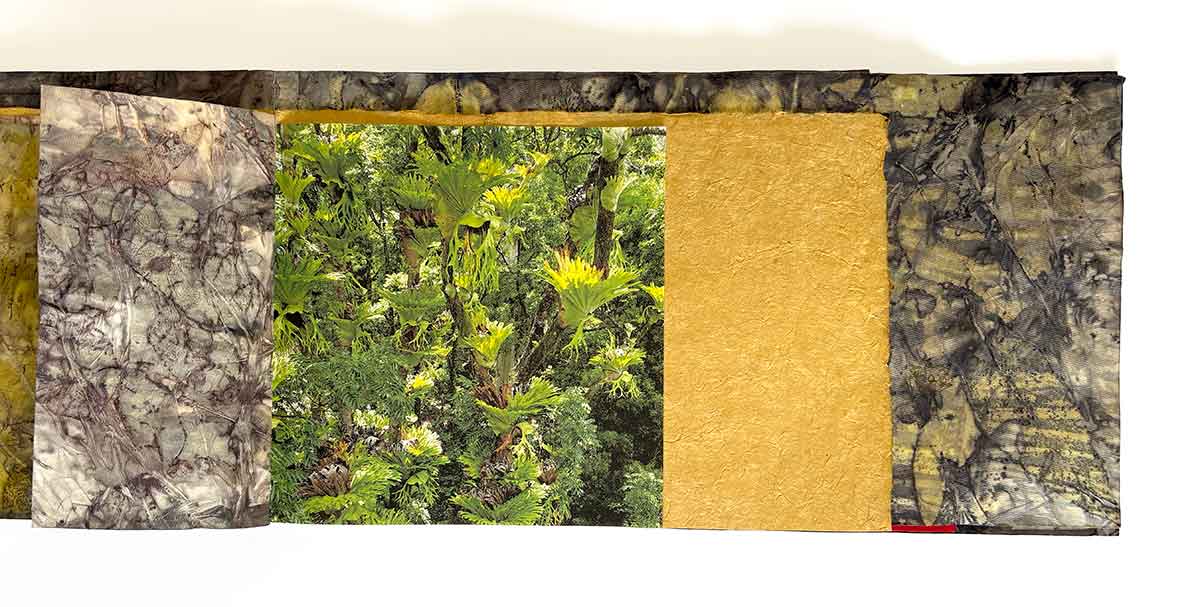
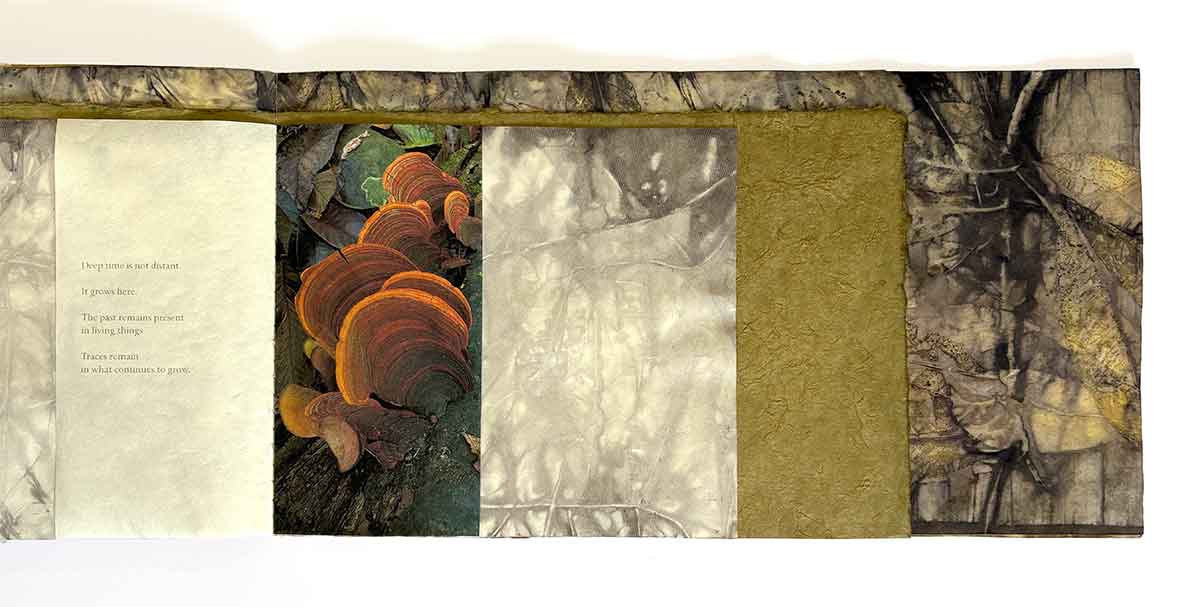
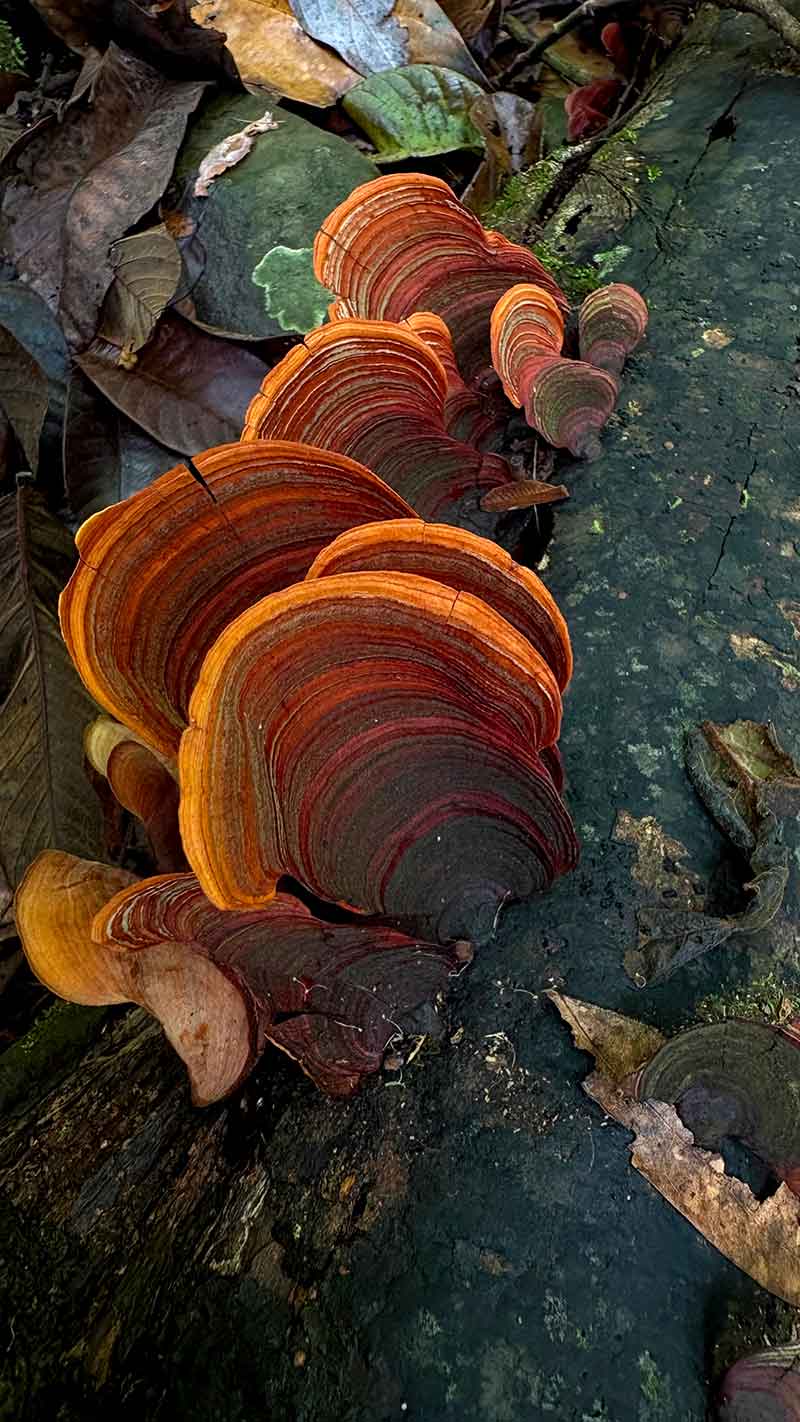
Photographs and small groups of words work with the papers to create sequence and rhythm. The photographs shift the viewpoint: looking up through a tree fern, into the branches of a red cedar, close to fungi and above the forest canopy.
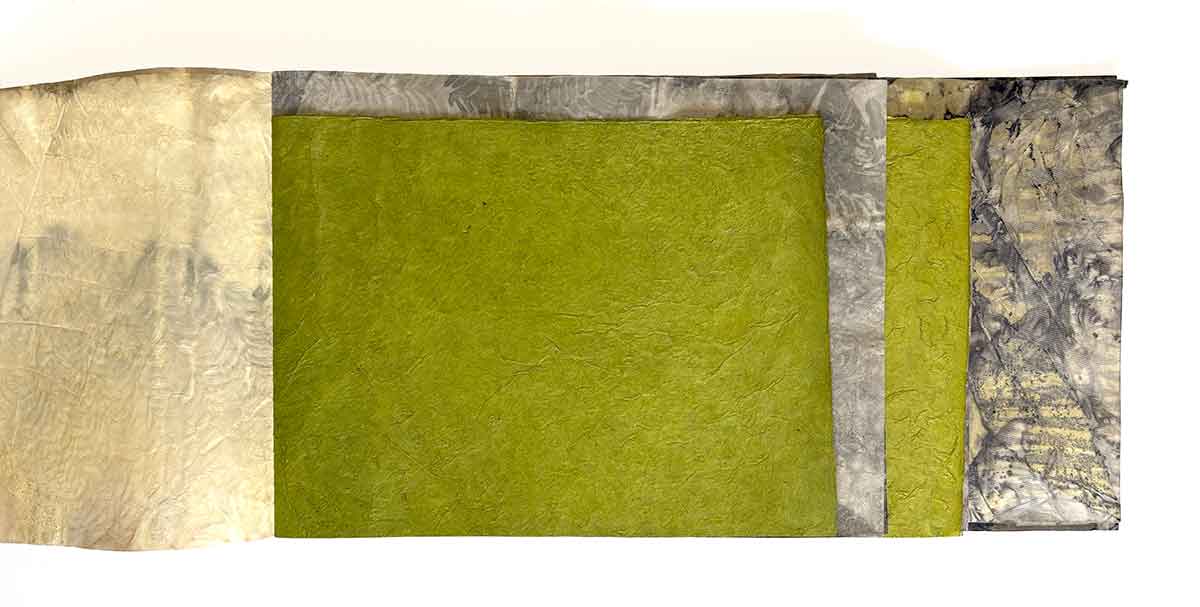
Handmade papers in green, olive and ochre create pauses among the eco-prints. One red sheet appears within the blue quandong section, echoing the extraordinary red its leaves become as they age.
Different kinds of time
The title Forest Time holds several meanings for me.
It is the time spent walking slowly enough to notice.
It is the time held within old trees and the cycles of germination, growth, decay and renewal.
It is the deep time carried through plant lineages far older than us.
It is also the time required to return and look again.
Forest Time does not try to explain a forest.
It offers an invitation to spend time with one.
The rest happens quietly.
A book that moves
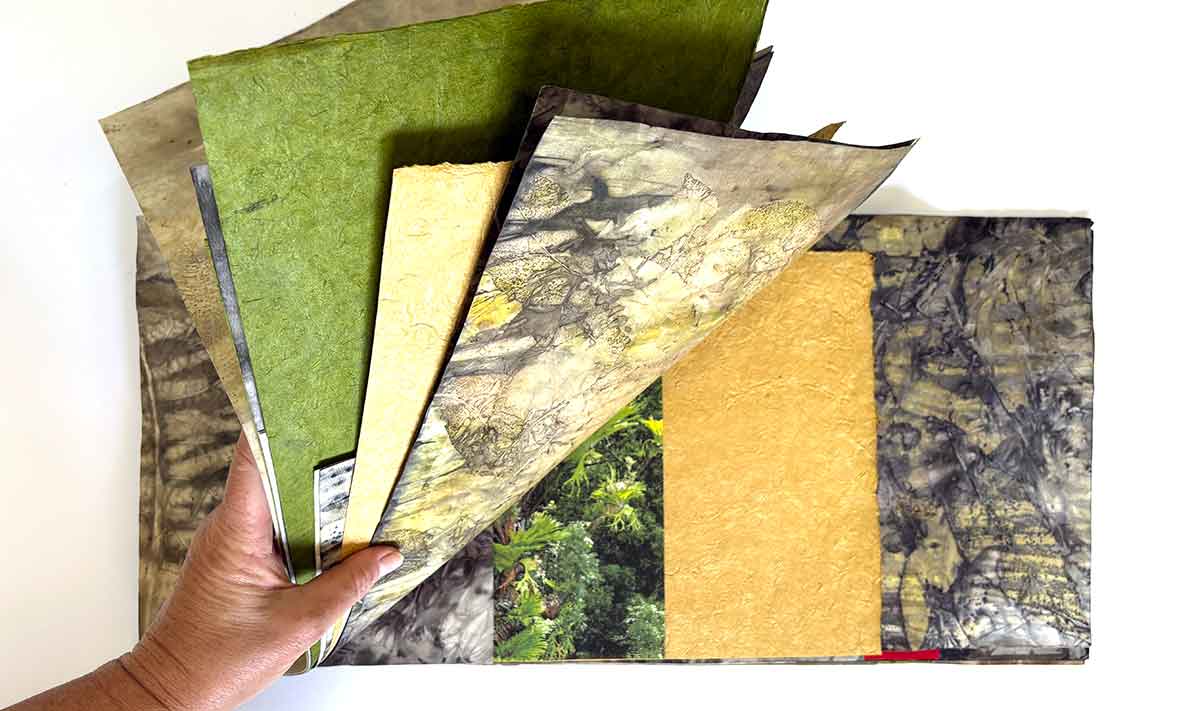
The five sections are sewn with running stitch to the mountain folds of a concertina spine.
The book can be spread out along a table, revealing its full length. The reader can then turn the individual pages within each section.
The sections hinge independently. As the large pages are handled, they shift and sway.
That movement belongs to the work.
Branches sway. Leaves move. Views open and close. No single position reveals every page or layer.
The structure came together clearly once I allowed the papers to lead, but physically making it was difficult. The scale that gave the book its presence also made the pages challenging to handle and stitch.
The finished structure asks the reader to move along it, open it and spend time with its changing layers.
Forest Time
Some things only reveal themselves
when movement stops.
Listen.
Not everything present
can be seen.
Life remains visible
around the edges.
The rest happens quietly
and unnoticed.
A hum moves through the canopy.
Wings move through spaces
between the leaves.
Nothing here exists alone.
Deep time is not distant.
It grows here.
The past remains present
in living things.
Traces remain
in what continues to grow.
Light shifts.
Branches sway.
Birds call.
We leave while the forest is speaking.
Each return continues the conversation.
Colophon
Unique state, 1/1
Structure: Five sections, each sewn with a running stitch to the mountain folds of a concertina spine.
Eco-printed pages: Awagami Bamboo 110gsm
Text and photograph pages: Archival pigment print on Awagami Kozo Heavy Natural 42gsm
Coloured papers: Handmade coloured paper, origin unknown.
Enclosure: Stitched envelope, Gmund Gentlemen Blue 300gsm
Text: Kim Herringe
Photographs: Kim Herringe
The Forest Unfolding
Forest Time is one of six artist books within The Forest Unfolding, a section of my Ghosts of Gondwana: In the Company of Trees solo exhibition.
Each book holds a different encounter with the forest, bringing together photography, printmaking, poetry and structure. You can read about all six books in The Forest Unfolding: six artist books asking us to slow down.