
The Forest Unfolding: six artist books asking us to slow down



Visitors often approach the artist books cautiously.
They lean closer.
They look at the pages.
Then they ask if they are allowed to touch them.
Yes. Please do.
Five of the books rest on tables. They are there to be opened, lifted, turned and unfolded. The sixth, Jewels of the Forest, hangs on the wall and is experienced by moving around it.
The books occupy their own quiet room, surrounded by the framed Living Traces works.
A book cannot be experienced all at once.
It asks us to slow down.
Why artist books?
I always intended artist books to form a major part of my Ghosts of Gondwana solo exhibition.
The framed works let me focus on particular plants, structures and relationships. The books gave me space to go deeper.
Through them, I could bring together words and additional imagery. I could use photography, poetry, printmaking and paper to share different parts of a story.
A book also introduces sequence and time.
An image appears, then disappears as a page turns. Words can be read slowly. Separate pages can be placed together. Layers can conceal and reveal what sits beneath them.
The reader controls the pace.
At first, visitors tend to handle the books carefully. They slowly grow more comfortable, lifting the pages and looking more closely at the stories they tell.
That interaction is part of the work.
The Forest Unfolding
The title The Forest Unfolding holds several ideas.
It refers to the physical act of opening and moving through a book.
It also reflects how my understanding of the property developed over repeated visits. I did not see everything at once. Each walk, photograph, conversation and return added something more.
The title also speaks to the forest itself. This is a place continuing to grow and regenerate after logging, clearing, grazing and lantana.
Across the six books, separate encounters begin to form a larger story.
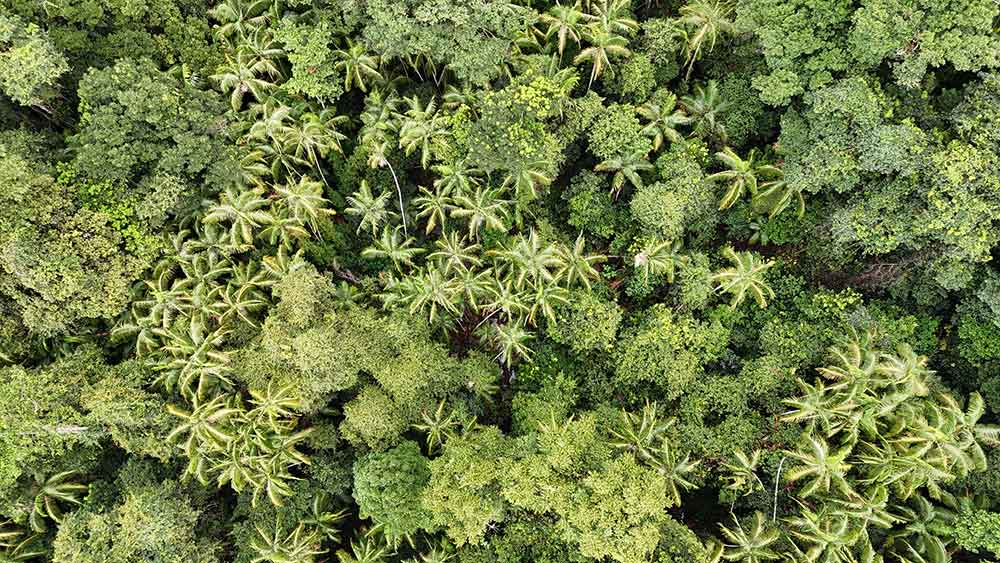
canopy
canopy was the first artist book I made for the exhibition.
Standing on the forest floor, we look upwards. In this book, drone photographs reverse that view.
From above, tree crowns meet and overlap. The forest becomes a living surface, revealing its extent while concealing much of the life below.
The photographs and poem consider what we can see and what remains hidden. Turning the stitched pages shifts the viewpoint again, allowing the reader to move slowly across the canopy.


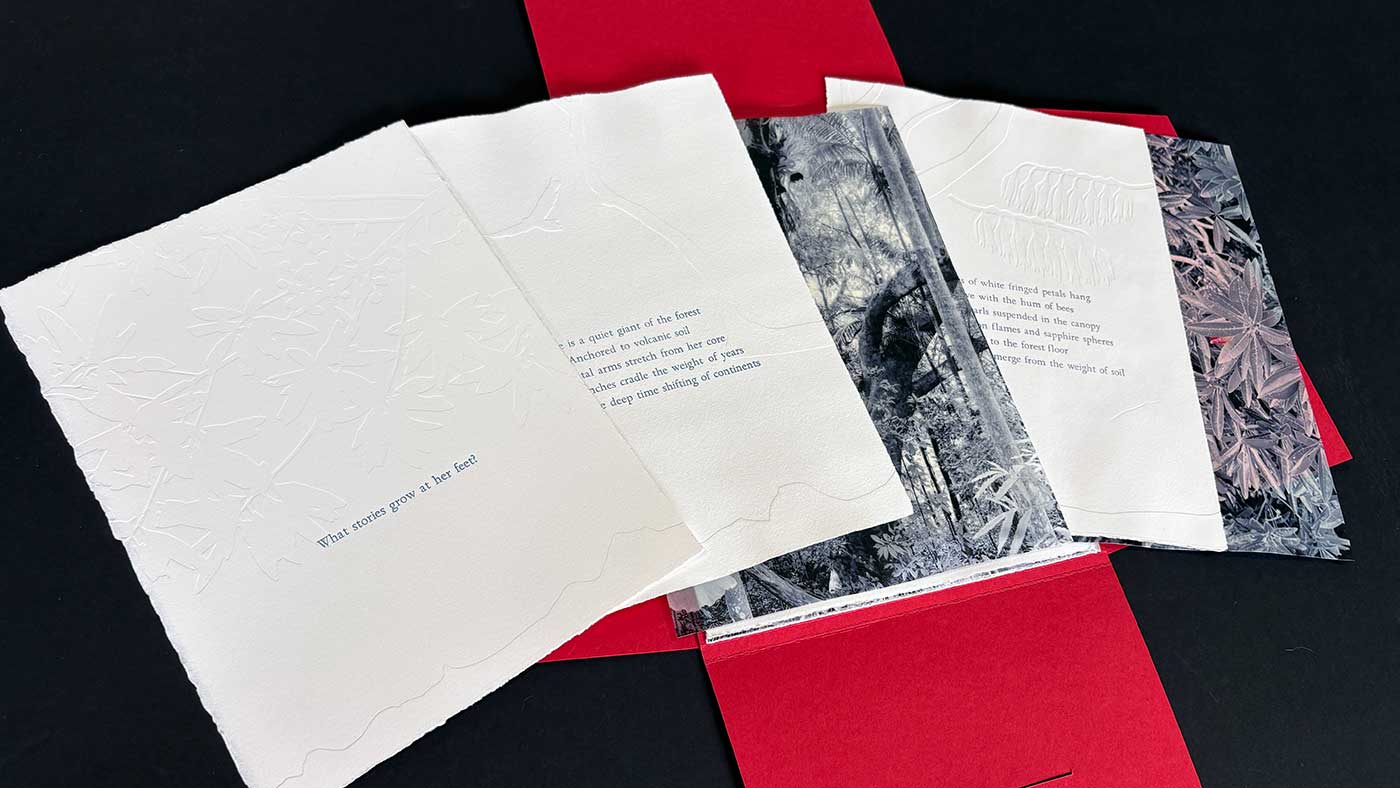
What stories grow at her feet?
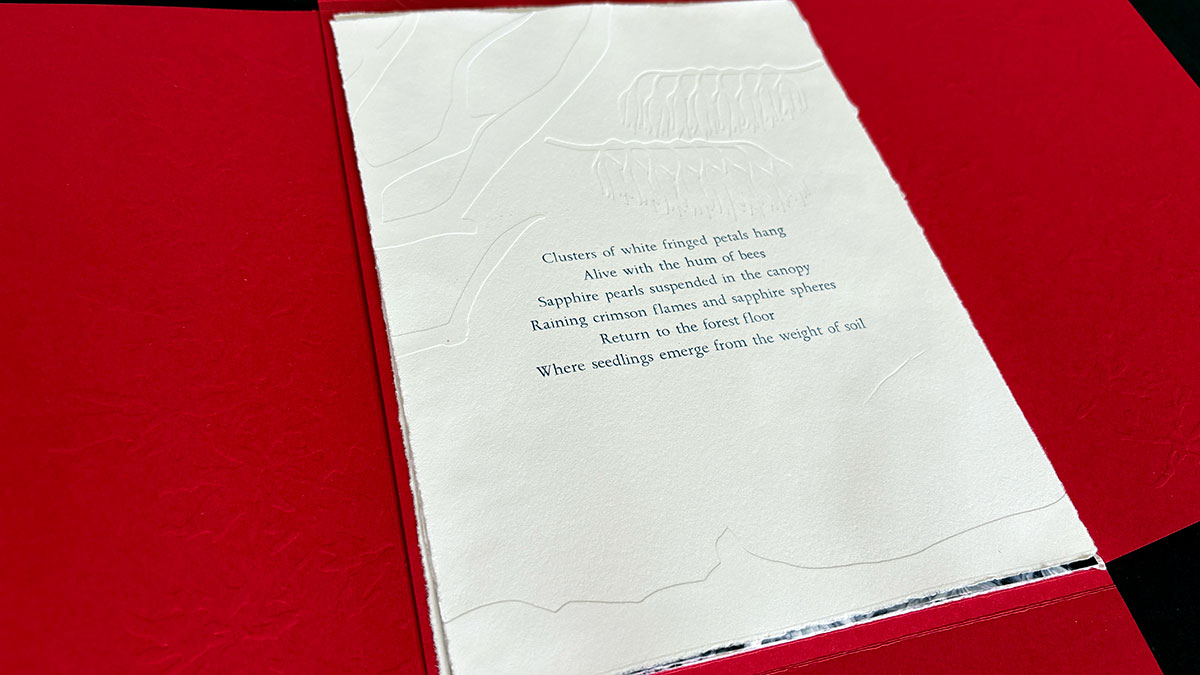
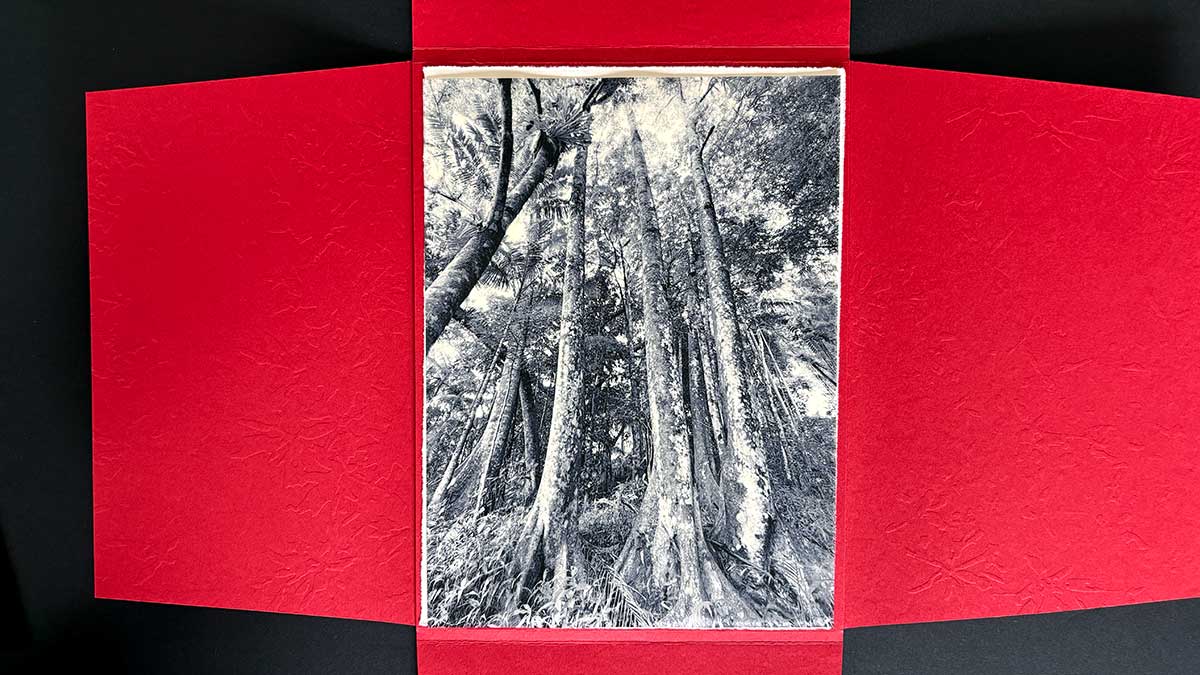
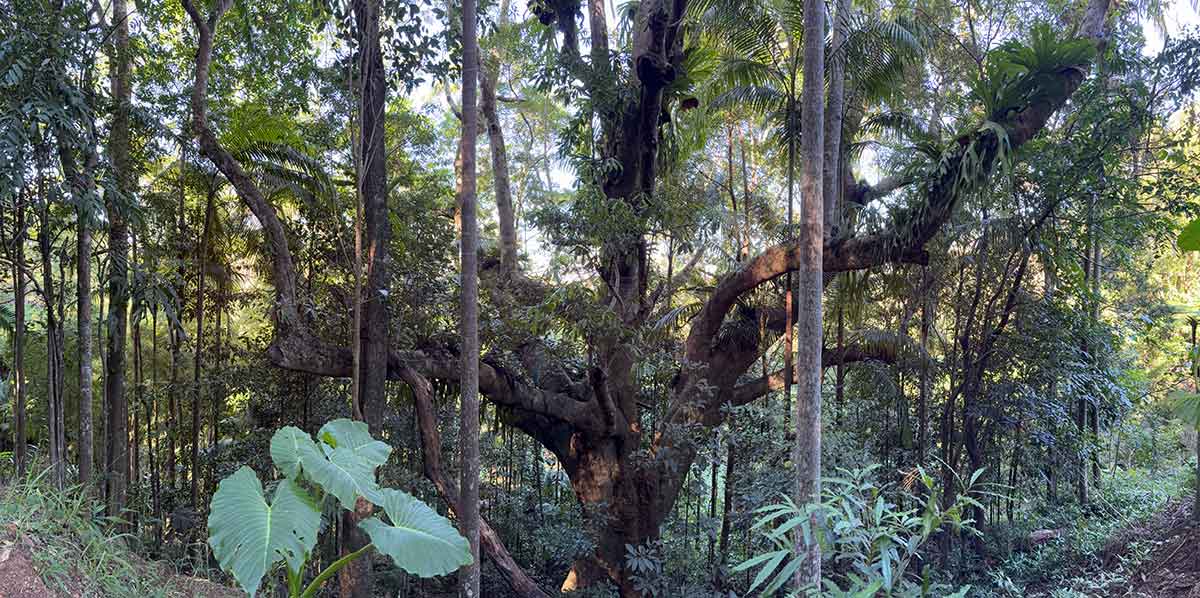
This book grew from my repeated visits to one enormous blue quandong.
Each time I returned, I saw more of her. Her trunk, branches, flowers and fruit. The bees humming within her canopy. The younger blue quandongs growing below her.
Across seven unbound sheets, photographs alternate with letterpress poetry and blind embossing.
The loose pages create pauses between image and verse. They can be lifted, moved and placed beside one another, echoing the separate visits through which I came to know the tree.
Her story continues through what falls, what feeds other life and what takes root beneath her canopy.

Jewels of the Forest
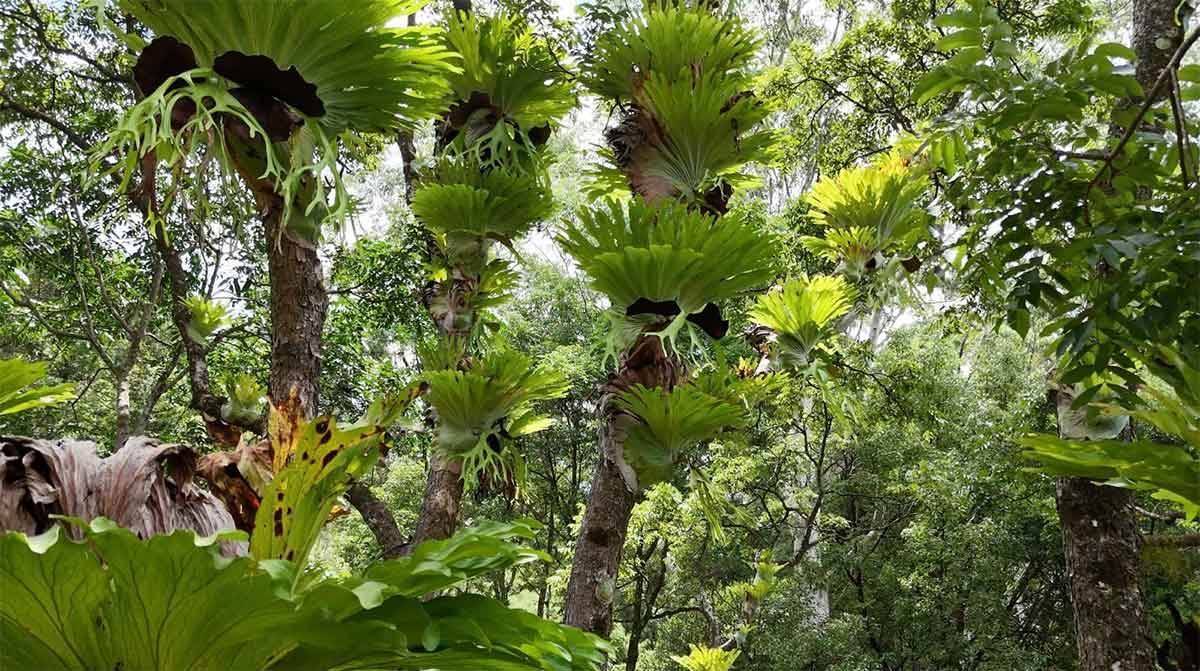
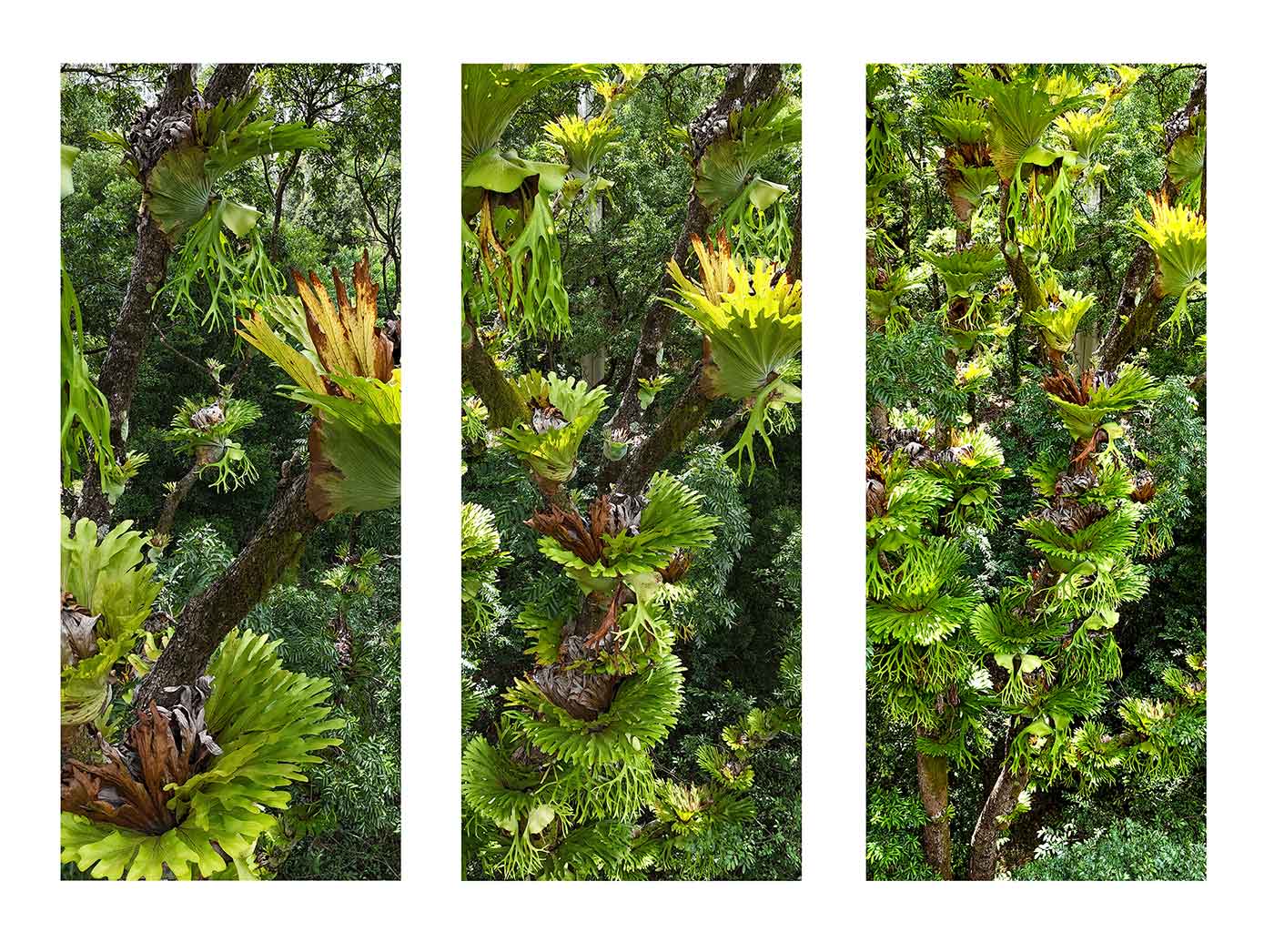
Vivid green staghorns smother the branches of an old red cedar like jewels.
I could see their beauty from the ground, looking up, but drone photography gave me a viewpoint I could never experience on foot.
Jewels of the Forest is made from three hanging banners. Each shows a slightly shifted view of the same tree from high inside her canopy. As the perspective rotates and draws back, more branches and more staghorns come into view.
Hanging the work gives the photographs a physical presence. The reader does not turn pages. Instead, they move around the suspended forms and experience the changing views.
Each staghorn holds a small ecosystem. Each is distinct, yet connected through the red cedar and the forest surrounding it.
A link to more information and images of this book is coming soon.

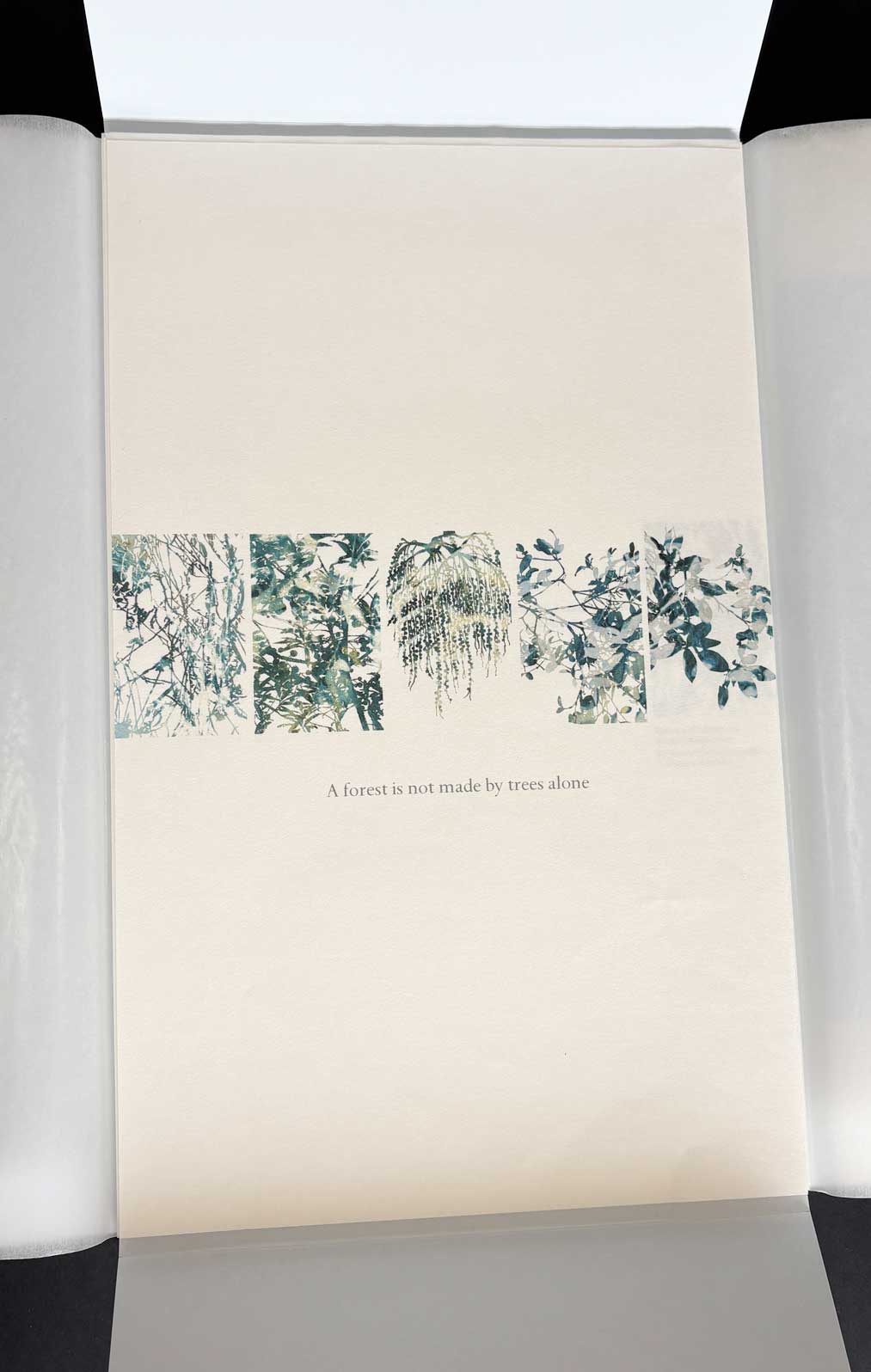
A forest is not made by trees alone
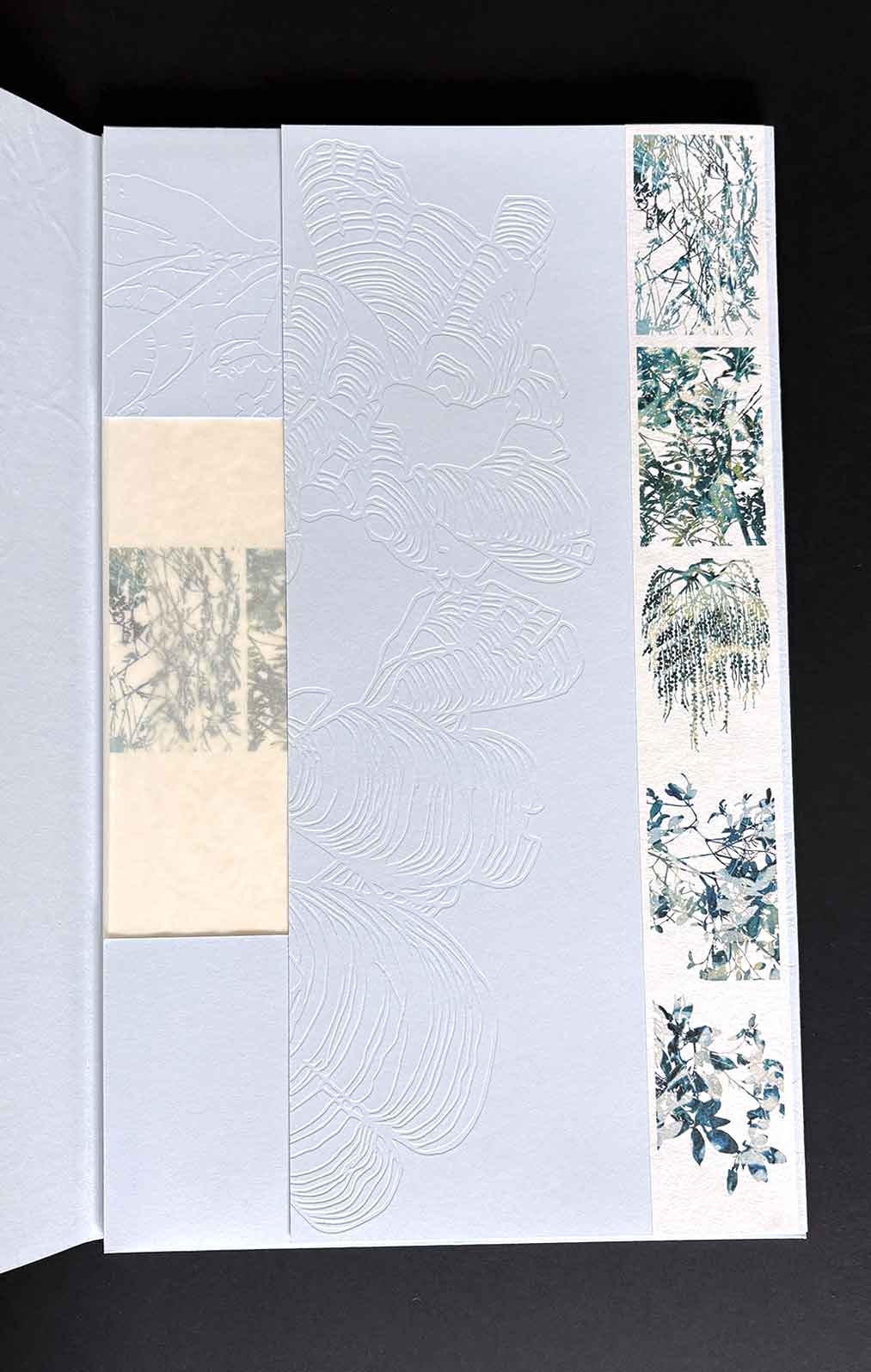
This book shifts attention towards what the framed Hidden Relationships works partly conceal.
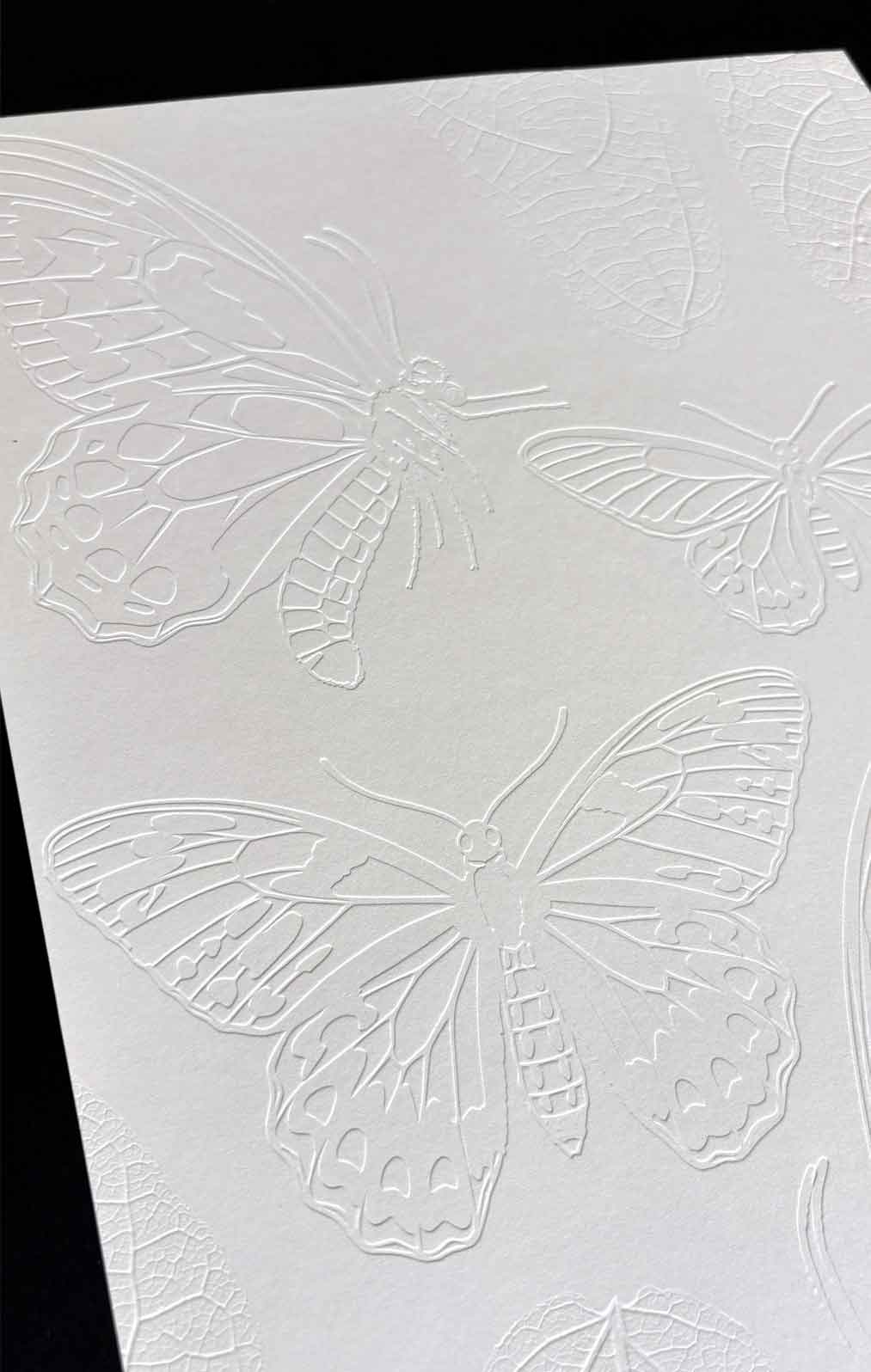
Five glassine folios contain blind embossings of birds, insects and plant structures. Each embossing is paired with a thin printed overlay carrying a question.
Who feeds here?
Who carries the seed?
Who moves pollen between flowers?
Lifting an overlay reveals the white-on-white image beneath. Light and shadow bring a butterfly, bird, bee or fig opening into view.
The unbound structure allows the reader to experience one relationship at a time or arrange all five together.
Looking, reading and lifting make the hidden connections visible.

Forest Time
Forest Time grew from walking, looking and listening.
It follows the experience of slowing down enough to notice what is present, sense what remains unseen and recognise that many lives share the same space.
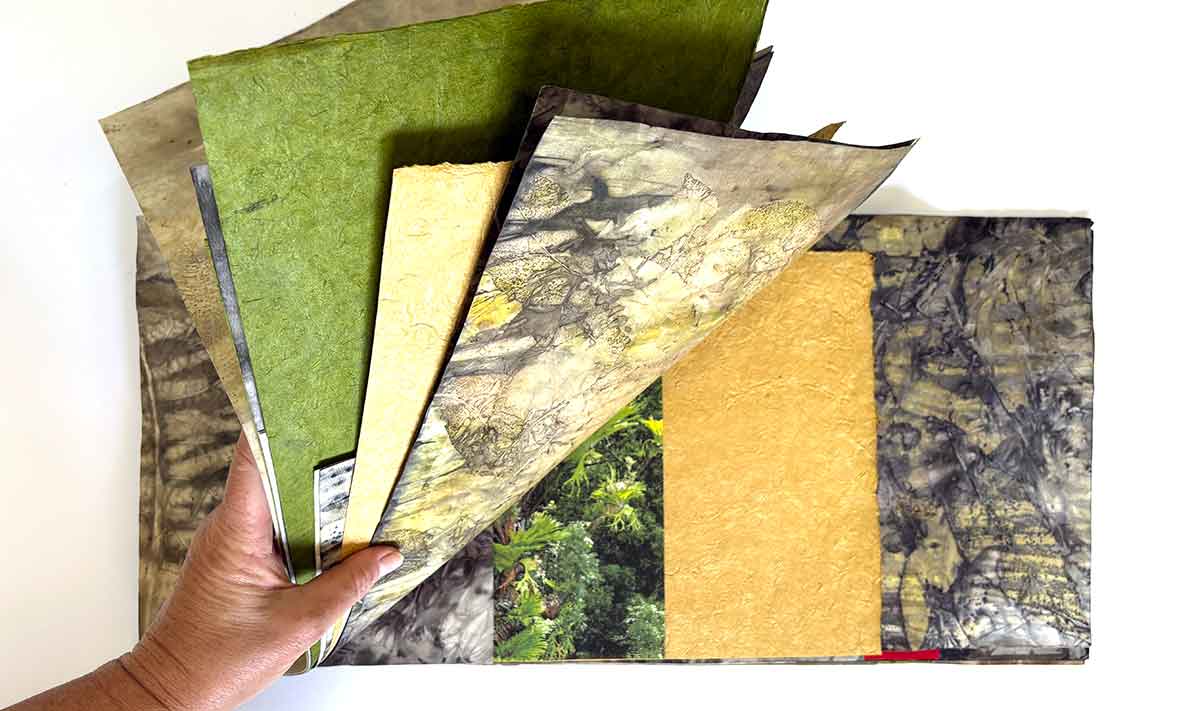
Leaves gathered from the property were eco-printed onto paper. Photographs and words sit among their imprints. Handmade coloured papers create pauses between the layers.
The pages overlap and extend beyond one another. No single view reveals everything.
The book is rooted in this property, but its experience can belong to any forest: stopping, paying attention and returning.
A link to more information and images of this book is coming soon.
Making Room
Making Room was the final artist book I completed for the exhibition.
It became a fitting encapsulation of the whole project.
The forest visible on the property today did not return without sustained work. The landowners cleared lantana, uncovered old trees, planted new growth and created space for natural regeneration to continue.
I wanted the book to hold before and after together.
Two books share a back cover and open in opposite directions. One moves through the lantana-covered property and the physical work of clearing it. The other shows the returning forest.
They can be read separately or opened together, allowing past and present to sit side by side.
The structure acknowledges both parts of the story: human effort making room and the plants, birds and insects continuing the work of renewal.
A link to more information and images of this book is coming soon.
Structure carries meaning
Every structural decision within these books is as intentional as the words and images.
Loose pages create pauses and allow different elements to be viewed together.
Glassine partially conceals what it protects.
Overlapping pages echo the layered growth of the forest.
Two books opening in opposite directions allow before and after to exist at the same time.
Hanging banners give photographs a physical presence on the wall.
The structure is not simply a container for the story. It helps tell it.
A larger story
These six books share many of the emotions and ideas that shaped Ghosts of Gondwana.
Awe.
Resilience.
Tolerance.
Interconnectedness.
Respect.
Relationship.
Memory.
Returning.
Each book begins with a different encounter. A tree seen from above. A blue quandong visited repeatedly. Staghorns growing on an old red cedar. Lives connected through food and pollination. The experience of walking slowly. A forest returning through years of care.
Together, they allow those encounters to gather into a larger story.
There were more books I wanted to make. Time ran out before the ideas did.
I will continue making them.
The Forest Unfolding is not an ending. It is a collection of stories that will continue to grow through new pages, structures, words and images.
For now, these six books ask the reader to pause.
To turn a page.
To look again.
And to give each story time to unfold.
The Forest Unfolding is one of four sections within Ghosts of Gondwana: In the Company of Trees. You can read an introduction to the complete exhibition in Four ways of looking: inside Ghosts of Gondwana.
The artist books and framed works are included in the Ghosts of Gondwana digital exhibition catalogue.
The exhibition continues at The Little Red Cottage art + ecology space in Maleny until Sunday 1 November 2026.