

Student Eco-printing On Paper Resources
STUDENT RESOURCES
This page shares information that I hope will encourage you to continue exploring eco-printing well after our workshop day.
Bookmark this page in your browser so you can keep referring back to it.
When looking for something specific, I encourage you to shop around for different pricing and sales.
And please let me know if you think I’ve left anything out!
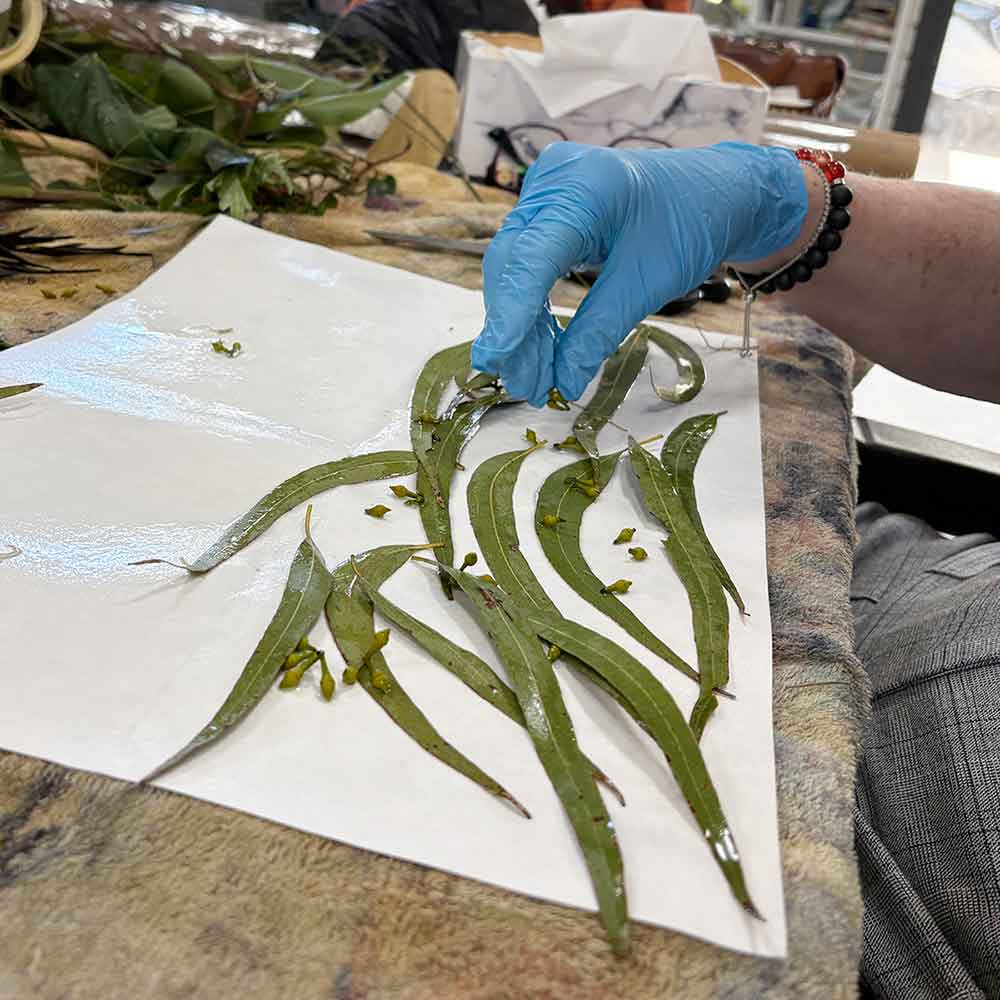
Wow what a day! This webpage shares information to support what we covered during our workshop. During our workshop we worked through the basics of the process, in various combinations. There is so much more to discover and explore . Fire up the burner, fill the pot with water, bundle your papers and eco-print away 🙂
The information below:
What now … ?
Now it is your turn to print, play and explore:
- Repeat the same steps at home that we have covered in the workshop, with your own plants and papers, and see how the results compare.
- And/or …
- Refer to the Bundle/Cook Overview matrix handout and mix’n’match different mordant, modifier, bundle and plant options to see how each combination can produce different or similar results;
- And/or …
- Read and research online to find out how other people take different approaches – and combine your learnings.
Pot 1, the first cook we did, is the easiest, simplest and most economical to get started. You just need some paper, botanicals, vinegar, water, a tin and iron or copper sulphate! Oh, and a heat source.
If you have experienced other eco-printers, books, reference links and learning resources that you think will be of interest, please share! Email me so I can add them to this page.
Eco-printing Reference Books
PRINTED BOOKS
There aren’t a great deal of printed reference books to buy, but these 2 are in my library:
Eco Colour: Botanical Dyes for Beautiful Textiles
Author: India Flint
Most online book stores and good street book shops will sell this book
the bundle book
Author: India Flint – soft cover approx $50 – downloadable pdf approx $20
ONLINE eBOOKS
These are books that I have bought. They range in price, and I found them all interesting and helpful in learning more about this process.
DIY Ecoprint on Paper in Color and Natural
Author: M Thersa Brown – approx AUD $65
Gum Leaf Alchemy: Eco printing on cotton
Author: Louise Upshall – approx $25
Plant Poetry: eco printing on paper
Author: Louise Upshall – approx $25
An Introduction to Leaf Prints on Paper: How to create amazing art using just paper, leaves and steam
Author: Cassandra Tondro – US $7
A Study of Leaf Prints on Paper: An investigation into the variables involved in the leaf print process
Author: Cassandra Tondro – US $7
MIRAGE PRINT eBOOK
To buy a copy of the eBook for the ‘Mirage Print’ or ‘Red Print’, visit Svetlana’s Facebook profile page Собко Светлана – and if you buy her book she will invite you in to her Private Facebook Group. This is a link to buy her eBook online – https://www.livemaster.ru/item/30302813-materialy-dlya-tvorchestva-mirages-ecoprint-on-cotton-t-shirt
Other Eco-printers to check out
Wendy Fe – Threadborne
Dye colours for eco prints
Dye plants for eco printing and eco dyeing
Barb – Made by Barb
Eco Printing on Cotton
Stunning Silk Eco Printing
Alternate Eco Print Processing – using the microwave oven!!
Chris – Joybilee Farm
How to Ecoprint on Silk and Make Fabulous One-Of-A-Kind Gifts
Emma Phillips
Eco Printing / Dyeing
Jo Horswill – Paper Cloth Studio
M Theresa Brown – The Silk Thread
Other Eco-printing learning resources to explore
Paper Cloth Studio – paperclothstudio.thinkific.com
Maiwa School of Textiles – maiwa.teachable.com
Nicola Brown on YouTube
Caroline Nixon – ecoprintwithcaroline.thinkific.com/collections
Four Rabbits – www.fourrabbit.com/tutorials
Eucalyptus
We all love those eucalyptus reds! I have found a few online resources looking at eco-printing and eco-dying with eucalyptus:
Sally Blake – Eucalyptus Dyes – www.sallyblake.com/new-page-15
Made by Bard – Oh Eucalyptus! – www.madebybarb.com/2021/01/22/oh-eucalyptus
Suzanne Dekel – Red eucalyptus eco prints- suzannedekel.com/post/red-eucalyptus-eco-prints
Social Media
FACEBOOK
These are some great Facebook Groups and Pages to check out to learn more about this process from other people. So much to learn!
Some INSTAGRAM tags to follow
- #ecoprinting
- #printingwithbotanicals
- #ecoprintingonfabric
- #ecoprintingonpaper
- India Flint on Instagram
Paper
YOUR WORKSHOP PAPERS
When you get home, give your workshop printed papers a rinse with fresh tap water. This will work to remove any residue sitting on the surface of the paper. You can iron the paper to remove any waves or wrinkles. I iron my paper when it is still quite wet.
BUYING PAPER
We eco-printed onto Awagami Bamboo 110/170gsm, Somerset 250gsm printmaking paper, Canson Montval 200gsm watercolour paper and Hosho Heavy Japanese printmaking paper. You can buy these papers from most art shops in-store and online.
Most printmaking papers will hold up to the process, as will watercolour papers. Good quality, thick cartridge can also survive – just be gentle and think about how ‘stiff’ the foliage it in the bundle.
Thin Japanese papers, with their long fibres, will generally hold up to the rigours of boiling and steaming.
Most art shops will sell printmaking and watercolour papers. And read a little more online, there will be clues about other papers that will handle the process.
Try eco-printing onto inkjet photographic paper.
Below are links to a new series of articles talking about paper. Beautiful, delicious, multi-purpose paper, with a focus on Printmaking paper:
- Paper Part 1 – What is Printmaking Paper
- Paper Part 2 – My Favourite Printmaking Papers
- Paper Part 3 – Storing Printmaking Papers (and answers to other questions you didn’t know you needed to know)
- Paper Part 4 – All About Paper Sizes
These are links to the papers we used in the workshop. Shop around for the best prices. You can copy the product name then do an online search to see who has the best prices product, and in stock. Keep the paper sales in June and November with Melbourne Etching Supplies in mind:
-
- Awagami Bamboo – mes.net.au/products/awagami-bamboo
- Somerset Satin – www.artshedbrisbane.com.au
- Canson Montval – www.artshedbrisbane.com.au
- Hosho Heavy – www.artscene.com.au
Mordants
A MORDANT works to bind the colours from plants (leaves, bark, roots or natural dyes) to the fibres you are printing on to. Mordants also helps to improve light- and wash-fastness.
Please refer to your “Mordanting Natural Dyes“ handout you were given during our workshop for more information about MORDANTS, and the different types of mordants that you can use.
Suzanne Dekel has written an interesting article about mordants and modifiers on her website. She explains mordants and modifiers, looking at acidic and alkaline environments. You can click a download link for the article for future reference. – www.suzannedekel.com/post/mordants-and-tannins-assists-and-modifier
Generally speaking:
– Alum (Potassium Aluminium Sulphate) is used as a mordant for protein fibres (eg. silk, wool); and
– Aluminium Acetate (AA) is used as a mordant for cellulose fibres (eg. papers, cotton, linen).
– An exception: silk is a protein fibre and does not need a mordant.
– I use Alum as a mordant for cellulose fibres, even though AA is the recommended mordant. Alum is cheaper and easier to buy.
– Metal salts (iron sulphate and copper sulphate) also act as a mordant to help bind plant colours to the paper/textile fibres.
Using SOY MILK as a mordant
I am experimenting with mordanting papers with soy milk. These sites share information if you want to start exploring that yourself now:
– Caitlan Irwin – How to make a soy milk mordant
– Gumnut Magic – Soy milk binder workshop
– Rebecca Desnon – Pretreating fabric in soya (soy) milk: FAQs
Buying Mordants and Dyes
I buy my dyes and mordants from Kraftkolour.
The dyes we used are natural dyes also form Kraftkolour. Please note that ‘natural’ does not automatically mean ‘non-toxic’ or environmentally sustainable or responsible. The dyes we use are, but I encourage you to do your own research around this when you look to buy natural dyes.
And don’t forget you can use iron sulphate and copper sulphate as mordants, and soy milk. You can make your own tannin mordants. There are lots of ways to mordant your fibres without having to source chemicals online. Don’t forget to reference back to the Mordant handout I gave you.
Eco-printing on Textiles
In essence, printing on textiles is much the same as we did on paper. You prepare your textile by soaking it in a mordant, or not, then bundle with leaves (leaves dipped in modifiers eg iron sulphave, alam acetate), consider using blankets, or not, then bundle and cook as we did our papers.
Cotton and linen are cellulose fibres. Silk and wool are protein fibres.
All above except silk MUST be mordanted before you bundle and cook them.
Silk does NOT need a mordant – simply soak in at 1:1 ration water:vinegar for 20 minutes before bundling, the treat the same as we did our papers above.
The links above will also introduce you to eco-printing artists printing onto textiles.
SEALING YOUR PRINTS
I like to use Renaissance Wax to seal and protect protect eco-printed papers in my bookmaking. I generally use this wax for papers where I think the colours from one paper may rub to another paper. I found a big range in price for this product, depending where you buy from, so shop around for the best price online.
- Renaissance Wax – 200ml – approx $40
- Renaissance Wax – 3kg – approx $175
You can also use a spray varnish or varnish medium.
ORANGE CAKE RECIPE
This is the recipe I use for the cake I made for our workshop. I make a few variations – swapping oranges for lemons or mandarins, and sometimes adding dark chocolate pieces. YUM.
I have created a private Facebook group ONLY for people who have attended my workshops. The idea is you can ask me questions, we share work, and I’ll share resources and information. Click the button below to join the conversation …